Why AI Won’t Kill Enterprise SaaS. It Will Force It to Grow Up

Lately, I’ve followed the debate around AI and Software as a Service (SaaS), which has grown far too simplistic.1 The conversation keeps circling the same provocation. Will agents replace applications? Will enterprise software lose relevance? Several major software vendors have pushed back on that idea, arguing that proprietary data, embedded workflows, and years of business context still matter.
I think the market is asking the wrong question. Although they are directionally right, I also think the real story runs deeper than a defense of SaaS.
AI is changing software faster than most people expected, but I do not buy the idea that enterprise platforms are suddenly optional. Enterprises do not run on sleek interfaces or clever prompts alone.
They run on systems that hold process logic, approvals, financial controls, compliance requirements, and the business's operational memory. Remove that foundation, and you miss out on the transformation, only to end up in confusion at scale.
That is why I see this moment less as a collapse and more as a maturity test. AI is not exposing the end of enterprise software. It is exposing the gap between shallow software and platforms that carry the truth of the business, which is exactly why the more useful question now is what the market still gets wrong about software’s role in an AI-led world.
The Panic Makes Sense. The Conclusion Does Not
I understand why this debate took off so quickly. Once AI started writing code, completing tasks, and moving across workflows with far less human effort, it was only a matter of time before people began asking whether applications themselves were becoming unnecessary.
If an agent can answer a question, trigger an action, and stitch together a process, the next assumption feels obvious. Maybe the interface no longer matters. Maybe the application layer starts to disappear.
That line of thinking sounds smart at first. I just don’t think it goes far enough.
What the market is getting wrong is this:
- Too many people are treating software as a front-end problem
- Enterprises do not run on screens alone! They run on systems of records
- AI can remove effort inside a workflow, but it cannot remove the need for a trusted workflow
That distinction matters more than most people admit. Enterprise software does far more than present information on a screen. It carries approvals, policy rules, compliance logic, transaction history, and years of business context.
So yes, AI may change the experience, but reducing friction is not the same as replacing the foundation because when I look at what enterprise leaders are asking for, they are not asking how to get rid of the core.
Enterprises Do Not Ask How to Replace the Core
That difference becomes obvious the moment you step out of the market debate and into an actual enterprise conversation.
Our clients are not asking how to bypass the core. They are asking how to make the core work harder for them. Across Oracle-led transformation programs, I keep hearing a much more grounded set of questions. They want AI to reduce friction, explain what changed, and help teams act faster inside the systems they already trust.
The questions I hear sound more like this:
- How do we make finance decisions faster?
- How do we make Oracle Enterprise Performance Management explain variance faster?
- How do we embed AI into supply chain decision flows?
- How do we reduce human effort in finance without giving up control?
I also see a very practical pattern among CXOs. They usually want to start with what is already available out of the box from an AI standpoint, prove the outcome in a real business process, and only then expand into larger initiatives. That approach makes sense. It lowers risk, creates internal confidence, and gives the organization a clearer view of where deeper transformation is actually worth pursuing.
What I do not hear is just as telling.
I do not hear clients asking how to rip out Oracle and replace it with a layer of agents or point tools. Serious enterprises know what sits beneath those platforms: controls, policies, auditability, and institutional memory. That is why I see AI as a platform multiplier, not a platform replacement. The real divide is not SaaS versus AI. It is shallow software versus deep platforms.
The Real Divide Is Not SaaS Versus AI. It Is Shallow Software Versus Deep Platforms
The real divide sits between software that only surfaces tasks and platforms that carry years of business logic, process history, and decision context.
You can see that shift in how major enterprise vendors are talking about AI themselves. Oracle is building AI around private enterprise data and embedding it directly into Fusion Applications, multistep agents, and business workflows.
Larry Ellison has been clear in Oracle’s own messaging that the company sees AI becoming deeply embedded across cloud applications, not floating above them as a disconnected layer.2 Salesforce is moving in a similar direction by tying AI and agents to Data Cloud, Customer 360, and trusted enterprise workflows, rather than treating AI as a loose overlay.
That tells me the market is already moving away from a simple “apps versus agents” story toward a harder question: which platforms have enough depth to become more intelligent without losing trust?
That is why proprietary context still matters.
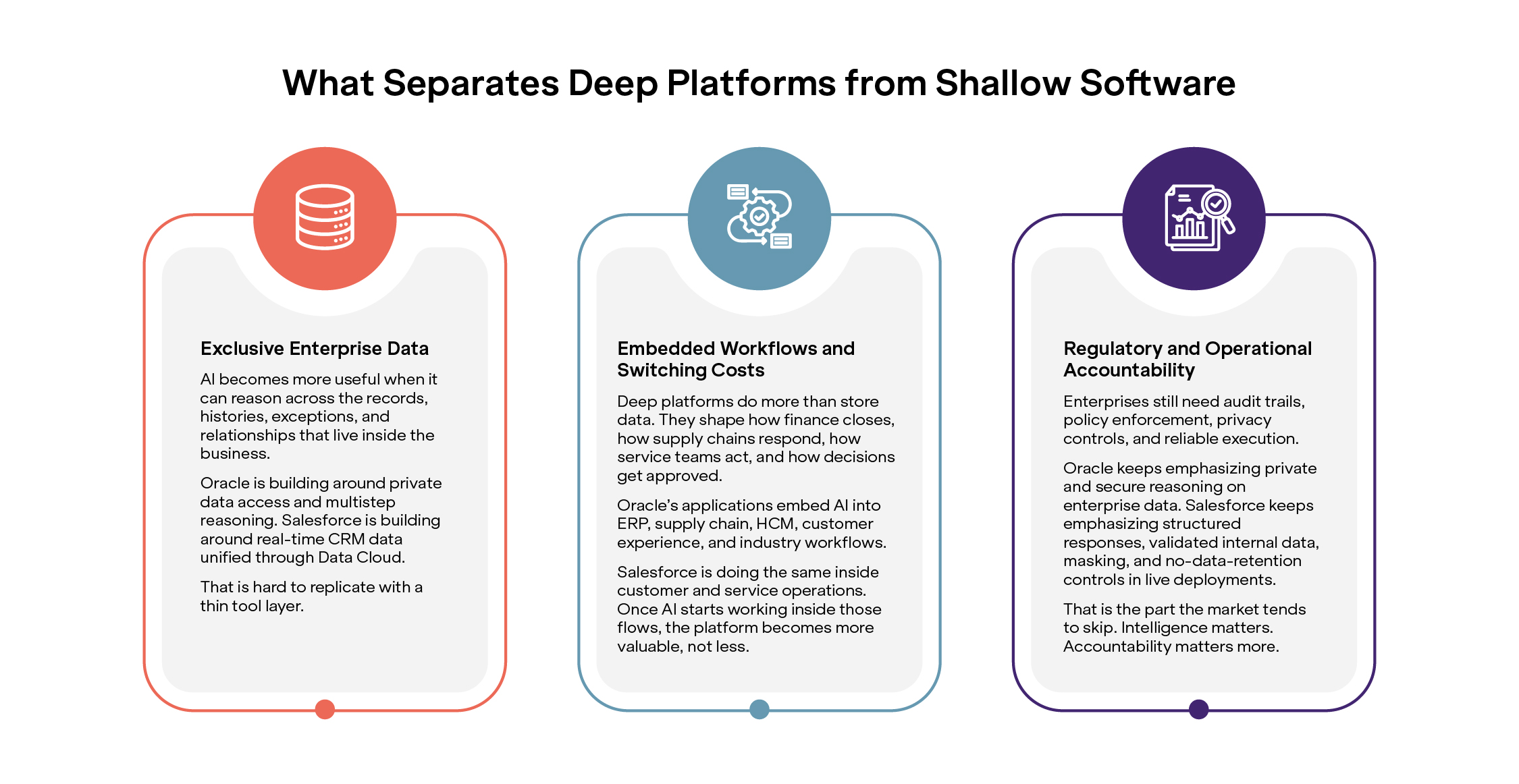
Figure 1: In an AI-led world, lasting software value comes from three things: business context, workflow depth, and trusted execution.
I keep coming back to the same conclusion. AI will expose weak software fast. It will raise the value of deep platforms even faster. And once that becomes clear, the next issue is no longer whether the interface changes. Of course it does. The more interesting question is: where does the platform still carry the truth underneath it?
AI Is Changing the Interface. The Platform Still Carries the Truth
Remember Satya Nadella’s framing at Microsoft Build? Years ago, he said that “human language is the new UI layer,” and Microsoft’s more recent AI narrative continues to extend that idea through natural, multimodal interaction and agent-led work. I agree with that direction.3 The interface is changing. We will ask, instruct, explore, and decide in very different ways than we did even a few years ago.
But a new interface is still just that. An interface.
It does not replace the ledger underneath a finance process. It does not replace the policy logic behind an approval. It does not replace the system of record that stores the transaction history, the compliance trail, or the business's operational context. It changes how people reach the truth. It does not change where that truth lives. That is the distinction I keep coming back to, and it is the reason I do not see AI as a substitute for enterprise platforms, but rather as a far more demanding test for them.
I think Dr. Vishal Sikka gets to the harder part of this debate. Across his interview commentaries, he keeps returning to the same enterprise reality: AI only creates real value when organizations can trust it, explain it, monitor it, and connect it to the systems where decisions actually happen.4 That matters because a fluent response does not create enterprise confidence. It is created when the response can be traced, checked, and acted on inside a governed workflow.
That is the part the market still underestimates. AI will absolutely reshape the experience of enterprise software. Menus will matter less. Conversation will matter more. But in any environment where accuracy, accountability, and control still matter, trusted outcomes will continue to depend on governed data and platforms that can carry responsibility. And once you accept that, the conversation shifts again, because the real opportunity is not to defend old software. It is to understand what enterprise platforms now need to become.
The Future of Enterprise Software
Enterprise software is shifting from transaction systems to decision systems. Workflows are becoming more adaptive and agent-driven. Users are starting to interact with enterprise systems in natural language, asking questions, triggering actions, and moving through workflows without always having to step through rigid screens and menus.
That shift is real, and it will change how work gets done across finance, supply chain, customer operations, and beyond. But a better interface does not automatically create a better foundation. When AI sits on top of weak platforms, thin process context, or poorly governed data, it creates confusion.
This is the part leaders should focus on now:
- AI without platform depth erodes trust
- Systems of record are becoming systems of intelligence
- Governance is harder than model selection
- Partners who understand platforms and processes will matter more
We have already seen what this looks like in practice. In manufacturing, LTM helped a global metals company connect 25+ systems through 100+ Oracle integrations, cutting support effort by 40% and saving 900 person-hours.
In insurance, we helped consolidate a 40+ application landscape with stronger integration governance and monitoring. And in supplier operations, we built a real-time Oracle-connected digital assistant that improved speed, accuracy, and support availability. In each case, the value did not come from AI in isolation, but from intelligence working inside a platform the business could trust.
AI has already changed the software game, and leaders are transforming the enterprise core with it. [JV6] Those who move well will use AI to make the core smarter, faster, and more useful without losing trust, control, or accountability.
That is also where Business Creativity becomes real: bringing human judgment and intelligent systems together to improve decisions, strengthen execution, and own outcomes that matter. And honestly, I think it is a much more interesting future than the one the market is arguing about today.
References
1. Software companies fight back against fears that AI will kill them, Aditya Soni, Reuters, March 12, 2026: https://www.reuters.com/business/software-companies-fight-back-against-fears-that-ai-will-kill-them-2026-03-12/
2. Oracle Announces Fiscal 2025 Second Quarter Financial Results, Oracle, December 9, 2024: https://www.oracle.com/sa/news/announcement/q2fy25-earnings-release-2024-12-09/
3. Satya Nadella and Terry Myerson: Build 2016, Microsoft, March 30, 2016: https://news.microsoft.com/speeches/satya-nadella-and-terry-myerson-build-2016/
4. A Discussion on Human Centered AI, Vianai Systems, June 28, 2022: https://www.youtube.com/watch?v=eMteYQE8cLY
 Outcreate Your Business
Outcreate with LTM
Outcreate Together

It’s time to Outcreate