Outcreate the Education Journey: AI Reimagines Enrollment And Student Success

In today’s education landscape, institutions are increasingly using predictive modeling to identify prospective students who are most likely to enroll. In the AI-era prediction alone is no longer enough. The next opportunity is to move beyond analyzing patterns and embed AI-driven action into the student journey, such approach will help institutions engage students earlier, personalize support, and improve enrollment outcomes.
Most universities are working on catch up, except IVY League institutions, which ahead in doing things differently. Having collaborated with several renowned Ivy League institutions, it is evident that artificial intelligence has evolved beyond predictive modeling and data analytics. AI is truly a strategic engine of change, reshaping enrollment, student success, and student outcomes in a way never done before.
The question is not so much if artificial intelligence has a place in higher education but whether any institution is ready to outcreate the old operating model before it becomes obsolete.
Why Reimagining Matters More Than Optimization
For years, higher education (HiEd) institutions have treated digital transformation as a set of point solutions. However, meaningful change demands a platform mindset. From my time helping universities unify Customer Relationship Management CRM and student information systems (SIS), I’ve consistently seen that legacy pipelines and manual handoffs create friction at every student touchpoint.
Within this context, the frameworks that Scrum Alliance described for ‘leading digital transformation in universities’ [1] become particularly powerful touchstones for the project team.
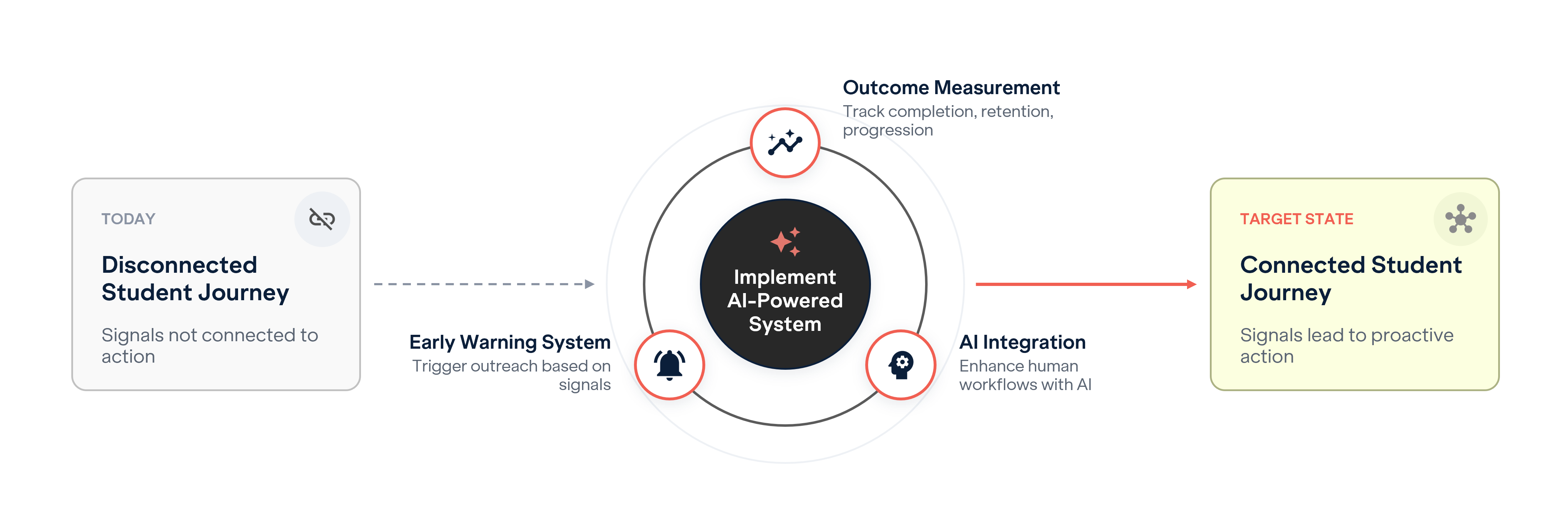
A reimagined student journey:
- Connects signals to action: Early warning triggers help to initiate outreach.
- Integrates AI into workflows: AI augments human capabilities.
- Measures outcomes directly: Completion/retention/progression are KPIs AI can impact.
Modern AI Means Agents That Act In Context
Ivy League universities are focused on developing not just "assistant" chatbots, but also AI agents that can be incorporated into current processes. For example:
- Predictive Enrollment Models: In Ivy League institution, data combined from recruitment with AI models to determine which prospective students would benefit most from focused outreach. Recruiters then use these insights to guide their follow-up actions
- Academic Risk Detection: Like enrollment, there are also AI models in place that allow the institution to track student performance and provide alerts and suggested actions to the relevant staff in CRM like Salesforce Education Cloud.
This is not just reactive automation; it is participatory AI. It serves to outcreate the way schools interact with learners throughout the lifecycle.
Platform Choices: Salesforce Education Cloud And Agent-Powered Solutions
In my experience, AI achieves its most meaningful results when platforms are in place that effectively link together data, processes, and outcomes. Salesforce Education Cloud, combined with AI agents built and deployed through Agentforce (a Salesforce platform for creating and managing AI agents) can provide that foundation. It strengthens:
- Comprehensive visibility into inquiries, applications, course progression, and results across multiple systems.
- Action in context from AI agents can suggest or even take follow up actions, within governance boundaries.
- Data is unified so predictive models get to see same signals across CRM, SIS, and LMS(Learning Management System) contexts.
This aligns with where the market is heading: ‘Gartner’s 2025 Market Guide for Higher Education Student Success Platforms’ [2] highlights how predictive analytics, early warning systems, and workflow automation are central to modern student success solutions.
Lessons From Innovation
Rather than simply experimenting with AI, these elite institutions have chosen to architect their use of technology. AI has streamlined the admissions process, drastically shortening the time required to reach decisions. Specifically, they used AI to normalize student transcripts to speed up the admissions process.
Another trend I’ve noticed is that several institutions are experimenting with AI advisors. These advisors are not like chatbots or virtual assistants that offer pre-programmed responses. Instead, they are AI agents that can summarize a student’s records and recommend actions to advisors prior to the student’s advising appointment.
Turning Data Into Actionable Signals
Data without action leads to interesting dashboards that won’t do a thing. Universities emphasize actions coming out of the data, such as:
- Students at risk of academic failure—trigger a defined set of actions.
- Students who have begun the application process but have not completed it, send targeted outreach to see if they will engage with the process.
- Advisors can view insights into the students’ performance.
By following these steps and focusing on engineering solutions that produce results—like those discussed in our LTM blog on data-driven student success’ [3], we can make sure the data we collect is used effectively to enhance the institution’s overall performance.
Governance And Trust: The Hard Part
Institutions often ask me: “How do we trust AI?” My response has three pillars:
- Transparent models: Everyone must understand what AI is doing and why.
- Human-in-the-loop control: Advisors and administrators retain oversight and can override actions.
- Iterative evaluation: Models and rules evolve based on measured outcomes.
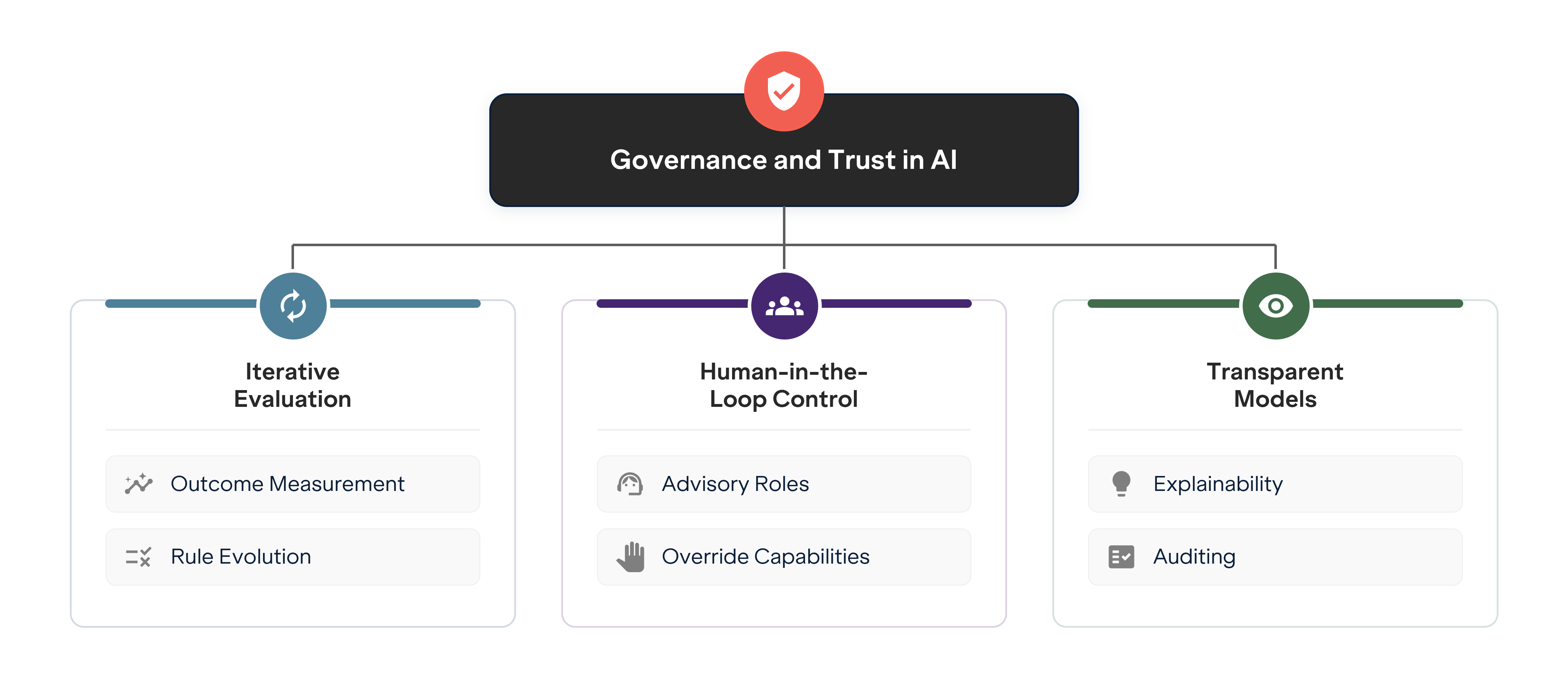
The best way to approach AI governance is as an ongoing institutional process. The establishment of these guardrails will allow for scalability in the automation processes.
In several implementations, institutions began giving AI agents a more limited set of permissions and then expanded those permissions in phases according to predefined metrics and success criteria for such expanded permissions.
Outcomes, Not Hype
While operational metrics are important to consider, the focus needs to be on the student outcomes, such as the following:
- Application completion rates
- Time to admission decisions
- First-year retention
- Course progression trends
Early admissions programs are increasing their yield by using AI-driven enrollment processes.
Conclusion: It’s Time to Outcreate Higher Education
There’s tremendous opportunity for higher education institutions to leverage intelligent systems within their existing workflows to achieve more cohesive student experiences. This is an opportunity much bigger than technology because it’s about reevaluating institutional operating models and capabilities. But if artificial intelligence initiatives are rooted in thoughtful consideration of enterprise platforms, governance, and outcome measures, education institutions stand a better chance of aligning strategy with mission and making an impact on students that matters.
References
- Scrum Beyond Software: Leading Digital Transformation in Universities with Agile Values — Agile Leadership; 12 January 2026 https://resources.scrumalliance.org/Article/scrum-beyond-software-leading-digital-transformation-in-universities
- Market Guide for Higher Education Student Success Platforms — Gartner; 24 February 2025 - https://www.gartner.com/en/documents/6200787
- Turning Insights into Impact: Data at the Heart of Student Success — LTM; 14 November 2025 - https://www.ltm.com/insights/blogs/turning-insights-into-impact-data-at-the-heart-of-student-success
About the Author
Vishal Shukla
 Outcreate Your Business
Outcreate with LTM
Outcreate Together

It’s time to Outcreate