Turning Insights into Impact: Data at the Heart of Student Success

Imagine a first-year student stepping onto campus, excited but uncertain about what lies ahead. Another learner logs into their university’s digital campus, balancing studies with work and family responsibilities. Though their paths look different, both share the same goal: success in higher education.
What determines whether they thrive, or struggle isn’t just the quality of instruction—it’s how well their institution understands and supports their journey. This is where data becomes transformative. Universities have always collected information on admissions, enrollment, program performance, and graduation rates. However, the real power emerges when these data points are connected across the student lifecycle. From the first point of engagement through graduation and beyond, institutions can gain a 360-degree view of each learner’s journey. Leveraging this insight allows educators to identify patterns, anticipate risks, and personalize support in ways that drive student achievement.
By placing data at the core, higher education institutions can move beyond intuition and tradition to evidence-driven strategies that enhance learning outcomes, retention, and long-term student success.
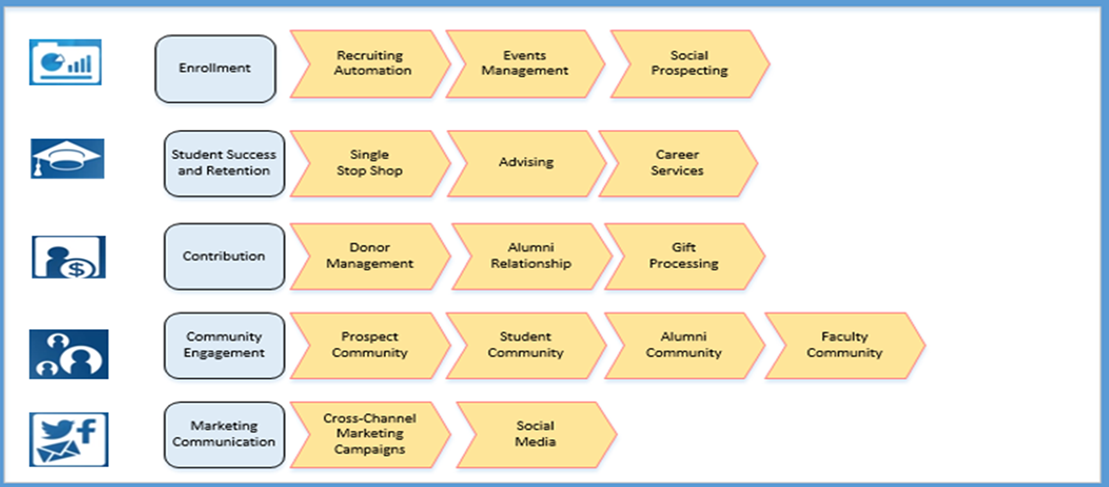
Beyond the Classroom: Navigating the Digital Campus Lifecycle
Student’s journey in higher education is not a single milestone but a continuous path that extends from the first touchpoint to post-graduation success. At every stage, interactions generate valuable data that, when connected, provides a complete picture of the learner’s experience:- Pre-Enrollment: Exploring programs, completing applications, applying for financial aid or grants, or attending virtual information sessions.
- Enrollment and Learning: Participating in classes (whether on-campus or online) engaging in discussions, submitting assignments, and receiving faculty feedback.
- Completion and Career Transition: Earning credentials, showcasing achievements on professional platforms, and exploring career opportunities.
Figure 1: Student Phase-wise Journey and Touchpoints
Unlocking the Digital Campus: Why Connected Data Changes Everything
The rapid expansion of digital learning has created a flood of information. Yet, when student data is scattered across siloed systems and disconnected applications, its true potential remains untapped. This fragmentation often leads to inconsistencies, missed insights, and delayed responses to student needs. A data-centric approach addresses this challenge by unifying information into a single, authoritative source. Leading universities recognize that centralized, well-governed data not only enables faculty and administrators to respond more effectively but also empowers students by aligning academic pathways with their strengths and goals. The benefits of this approach are clear:- Personalization at Scale: Institutions can adapt content, pacing, and support to match individual learner needs.
- Equity and Inclusion: Analytics help uncover underserved groups and guide targeted interventions to close learning gaps.
- Continuous Improvement: Data-driven insights inform curriculum design, faculty development, and resource allocation.
From Silos to Success: Integrated Data for Better Outcomes
Adopting a data-centric model in higher education requires more than just technology—it demands a coordinated blend of systems, analytics, and culture. Institutions that lead in this space are leveraging technologies and tools such as:- Unified Data Platforms: Connecting enrollment, learning management, career services, HR, and other systems into a single integrated view.
- Advanced Analytics and AI: Using predictive models to identify at-risk students, recommend learning pathways, and track engagement in real time.
- Actionable Dashboards: Equipping faculty, advisors, and administrators with intuitive tools to intervene early and guide students effectively.
- Data Governance and Ethics: Establishing clear policies to ensure responsible data use and maintain student trust.
- Matching students to courses aligned with their interests.
- Monitoring performance and identifying areas for academic improvement.
- Predicting potential dropouts and suggesting timely interventions.
- Understanding course dependencies to guide enrollment decisions.
Conclusion: Your Digital Campus Data Strategy
A data-centric approach is the essential foundation for enabling a thriving digital campus. To achieve this transformative vision, higher education institutions must embrace unified data layers that establish a single source of truth across all systems and touchpoints. Solutions such as Salesforce Education Cloud, integrated with , provide a powerful framework to achieve this vision.References
- Approaching Student Success With Predictive Analytics. Tim Renick, Georgia State University — Student Success Programs. Nov 7, 2025. https://success.gsu.edu/approach/
 Outcreate Your Business
Outcreate with LTM
Outcreate Together

It’s time to Outcreate