From Signal to Certainty: A Point of View on Where Industrial AI Proves Its Worth
Background
Industrial enterprises have invested heavily in digitization over the past decade. Sensors, historians, and monitoring systems now generate vast volumes of operational data across plants. Dashboards visualize performance in real time, and alerts signal deviations as they occur.
Yet, despite this progress, a persistent gap remains between data availability and actionable decision-making. The ability to detect anomalies has improved significantly, but the ability to diagnose and respond with certainty has not evolved at the same pace.
This gap becomes most visible during critical operational moments. When an anomaly surfaces, such as a drop in compressor discharge pressure, the system signals the issue immediately. However, what follows is often a fragmented and manual process. Engineers must correlate data across systems, interpret alarms, consult historical records, and rely on experience to determine the next step.
In such environments, decision-making is still dependent on individual expertise rather than institutional intelligence. This introduces variability, delays, and risk.
It is in this context that first-level diagnostics emerge as a critical capability. It represents the point where industrial AI must move beyond detection and begin enabling structured, reliable decision-making.
Introduction and Hypothesis
It is 2:40 a.m. in a high‑throughput industrial plant. A compressor shows a drop in discharge pressure. Alarms trigger and the dashboard lights up. Nothing has failed yet.
At this moment, the organization’s digital maturity not measured by how much data it has collected or how advanced its analytics models are. It is measured by a single question:
Can the team move from signal to certainty fast enough to act with confidence?
This is where most industrial AI initiatives quietly struggle.
While systems are effective at generating alerts, they often fail to provide clear, actionable diagnostics. Engineers are left to interpret signals, connect disparate data points, and determine root causes under time pressure.
The hypothesis presented here is clear:
Industrial AI delivers measurable value only when it enables deterministic, domain-aware first-level diagnostics that guide decisions in real time.
Without this capability, AI remains an alerting mechanism. With it, AI becomes a decision-enablement system that can be trusted in critical operational moments.
The Invisible Gap Between Data and Decisions
Industrial environments are inherently complex and distributed. Data exists across multiple systems, each designed for specific functions. Time-series data resides in historians, alarms are managed separately, and maintenance records are often stored in enterprise systems or documents.
Engineers navigating an anomaly typically encounter a fragmented landscape:
- Time‑series data in one system
- Alarm streams in another
- Maintenance history buried elsewhere
- Engineering standards locked in documents or tribal knowledge
When anomalies appear, teams are forced into manual correlation. This leads to:
- Delayed decision-making
- Repetitive investigations
- Increased reliance on individual judgment
- Inconsistent outcomes across shifts and teams
The issue isn’t the absence of technology. It’s the lack of a structured, domain‑aware diagnostics, that bridge operational knowledge with digital intelligence.
This is where domain–technology convergence becomes essential. It shifts the focus from simply collecting and visualizing data to interpreting it within an engineering context.
Strategy and Solution: A Deterministic Approach to First-Level Diagnostics
In mature industrial environments, first-level diagnostics does not depend on individual heroics. It follows a deterministic and repeatable process, aligned with standards such as ISO 14224 and grounded in engineering logic.
Instead of asking engineers to determine the next step, the system guides them through a structured workflow.
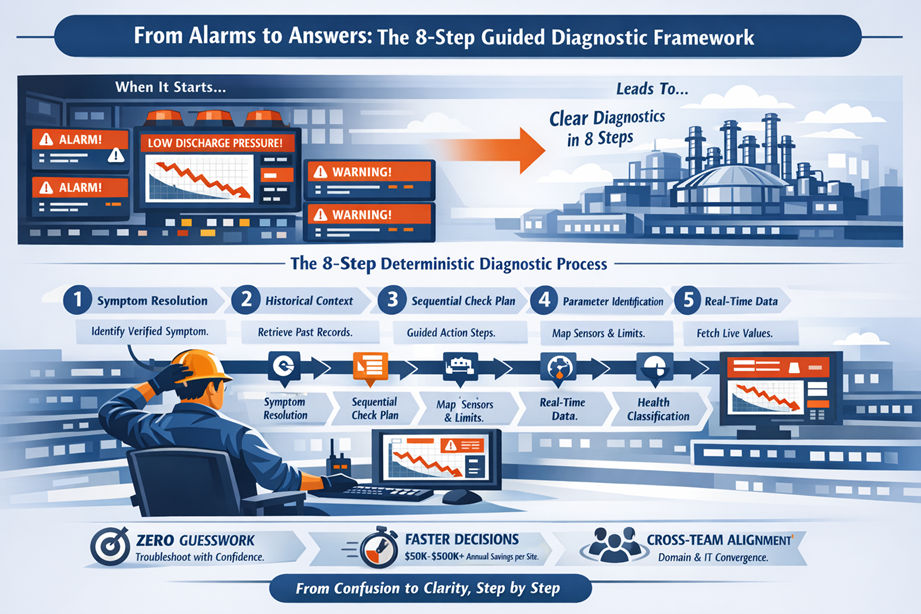
At the center of this approach is an 8-step guided diagnostic framework, designed to convert scattered signals into actionable clarity.
The 8‑Step Deterministic Diagnostic Process
- Step 1 – Symptom Resolution
An observed anomaly, such as low discharge pressure, is mapped to a verified symptom within an industrial knowledge graph. This removes ambiguity at the outset.
- Step 1.5 – Historical Context Retrieval
The system retrieves relevant past failures, maintenance events, and operational patterns associated with the symptoms. Engineers begin with context rather than starting from scratch.
- Step 2 – Sequential Check Plan
A prioritized diagnostic path is generated, outlining:
● Where to look
● What to measure
● What to do next
The process becomes guided rather than improvised.
- Step 3 – Parameter Identification
Critical sensors and operating parameters such as pressure, temperature, and vibration are automatically mapped to each diagnostic step, ensuring completeness and consistency.
- Step 4 – Metadata Verification
Ranges, units, and thresholds are validated against OEM standards and engineering references. This ensures that data interpretation is accurate and aligned with domain knowledge.
- Step 5 – Real‑Time Value Retrieval
Live plant data is integrated into the diagnostic process in real time, enabling immediate analysis rather than retrospective evaluation.
- Step 6 – Health Classification
Values are evaluated deterministically and classified as normal, warning, or abnormal. This reduces noise and focuses attention on critical deviations.
- Step 7 – Relationship Reasoning
Cause-and-effect relationships encoded in the knowledge graph are used to confirm or eliminate potential failure modes. The system applies consistent reasoning aligned with engineering logic.
- Step 8 – Final Output
The outcome is a concise diagnostic summary that includes:
● Ranked probable root causes
● Supporting evidence
● Clear recommended next actions
This eliminates ambiguity and enables immediate, confident decision-making.
Why Domain-Technology Convergence Makes This Work
The effectiveness of this approach lies not in AI alone, but in the integration of domain expertise with digital intelligence.
Engineering knowledge provides the foundation:
- Standards guide data interpretation
- Maintenance history informs diagnostic probabilities
- Asset topology explains how issues propagate
- Digital intelligence executes the logic consistently, every time
This convergence ensures that troubleshooting is repeatable, auditable, and explainable, even as experienced personnel rotate off shifts or leaves the organization.
In practice, this means:
- Zero guesswork during critical moments
- Faster, evidence‑based decisions
- Alignment across operations, maintenance, and reliability teams
The diagnostic process becomes a shared institutional capability rather than an individual skill.
The Impact: Confidence at the Point of Decision
When first-level diagnostics become structured and deterministic, the impact is immediate and measurable
Unplanned events are identified and addressed earlier, reducing downtime and operational disruption. Maintenance actions become more targeted, improving efficiency and resource utilization. False alarms decrease as context replaces noise, allowing teams to focus on what truly matters.
Across industrial environments, this approach has demonstrated annual value generation in the range of $50K–$500K per site. This value is not driven by large-scale automation, but by improving the speed and quality of first responses.
Beyond financial outcomes, the deeper impact is cultural. Engineers begin to rely on systems that support their decision-making rather than complicate it. AI transitions from being perceived as an alert generator to functioning as a trusted operational partner.
This shift is critical. Trust is not built through accuracy alone, but through consistency, transparency, and alignment with human reasoning.
Closing Thoughts
Industrial AI will not be defined by the sophistication of its algorithms, but by its ability to guide decisions in moments of uncertainty.
First-level diagnostics represents the point where this capability is tested most rigorously. It is where data must translate into clarity, and where systems must support action without ambiguity.
When diagnostics remains unstructured, AI adds noise to already complex environments. When it is designed as a deterministic, domain-aware process, AI becomes a reliable guide.
The distinction is fundamental.
Get first-level diagnostics wrong, and organizations continue to rely on fragmented workflows and individual expertise. Get it right, and they establish a scalable, repeatable foundation for operational excellence.
In the end, the true measure of industrial AI is not what it predicts, but how effectively it enables people to act with confidence.
Contact Us
 Outcreate Your Business
Outcreate with LTM
Outcreate Together

It’s time to Outcreate