Reimagining the Future of Consulting with Sentient AI

Why or What is Sentient AI?
Sentient AI, sometimes referred to as 'mind AI' imagines a world where artificial intelligence systems possess human-like consciousness, self-awareness, and subjective experiences. Today's AI systems, while powerful, are not sentient. They perform tasks like simulating human conversations, automating processes, or analyzing large datasets, often appearing to replicate human interaction but lacking true awareness. Sentient AI is capable of feeling and experiencing emotions like humans. It possesses emotional intelligence, consciousness, and the ability to perceive its surroundings, transforming these perceptions into emotions. In essence, sentient AI can think, feel, and perceive just like a human being. The leap from current AI to Sentient systems involves concepts like Theory of Mind AI, where machines could potentially understand human emotions and engage in meaningful social interactions. This evolution holds transformative potential for industries like consulting, where insights and advice need to blend analytical depth with human-like intuition and empathy.
How Sentience is Achieved?
Sentient AI could be built upon large language models (LLMs) powered by neural networks capable of identifying patterns, simulating nuanced conversations, and analyzing complex data. Its distinguishing traits would include:
- Consciousness: Awareness of itself, its actions, and its environment
- Emotional intelligence: Recognition and expression of emotions like joy or sadness
- Learning and adaptation: The ability to adapt to new situations and improve its skills over time
- Empathy and social interaction: Understanding human emotions and engaging meaningfully
- Autonomy and function: Making independent decisions driven by motivation
- Creativity and imagination: Generating new ideas, solutions and artistic expressions
Present State of AI in Consulting and Potential Benefits of Sentient AI in Consulting
While true sentience is a distant possibility, current AI technologies already offer immense value in consulting by enhancing decision-making and operational efficiency. Benefits of Sentient AI, if realized, would take this further by providing tailored proposals. This would mean delivering recommendations highly specific to client needs, grounded in a deeper understanding of their goals and constraints. While the existing AI applications are valuable and effective, it is important to note that they do not contain Sentient artificial intelligence. Rather, they use advanced machine learning, natural language processing and automation techniques to augment human capabilities and improve business results. Integrating sentient AI into IT consulting services could change the industry by enabling consultants to deliver tailored proposals to clients that are more specific to the customers requirements. The future of fully Sentient AI in IT consulting remains speculative. However, current AI capabilities hint at how IT consulting services could evolve with Sentient AI. Here are some of the ways AI is currently being used in business environments and how Sentient AI could augment these services: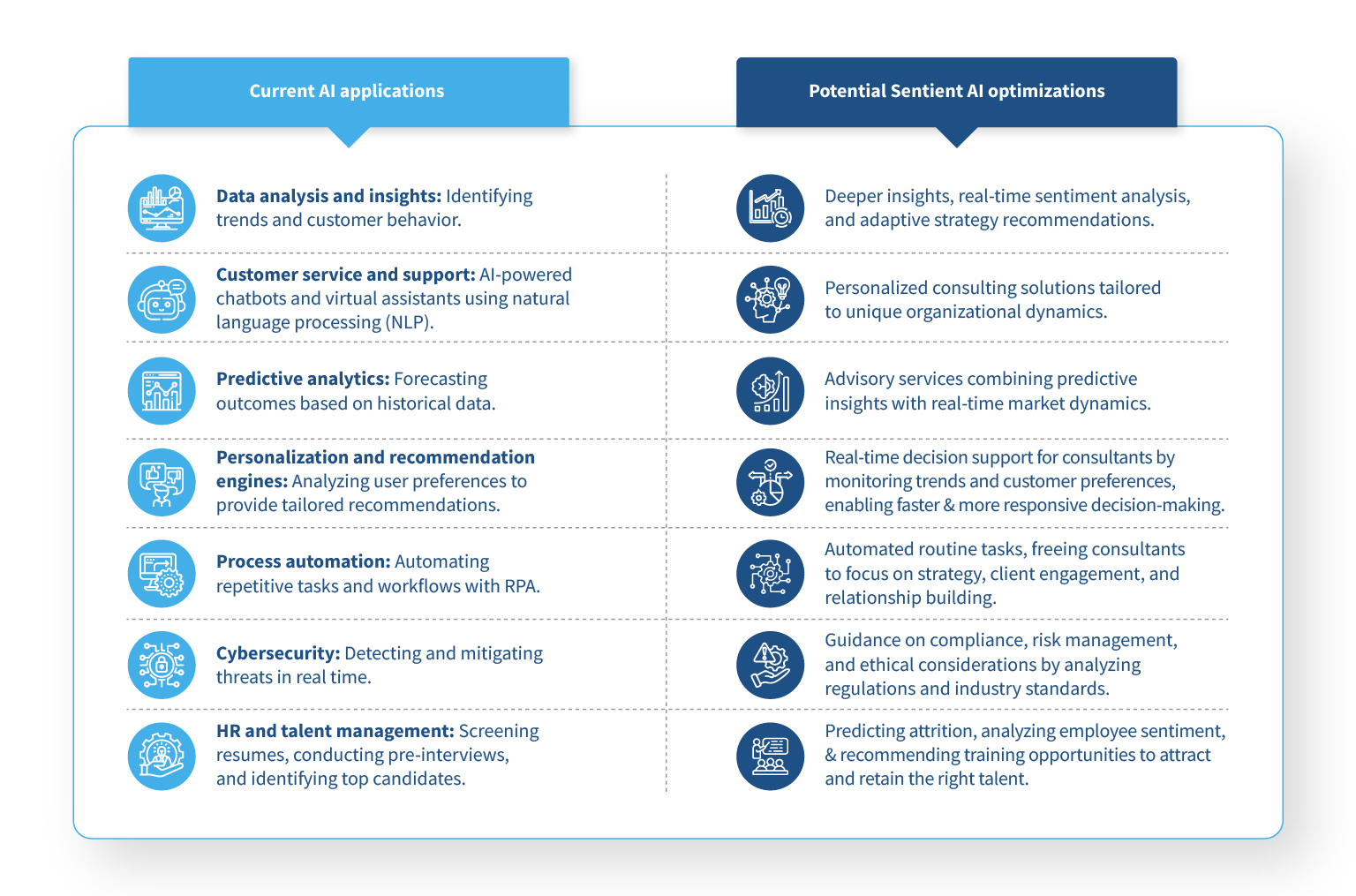
Ancillary Benefits of Using Sentient AI
- Continuous learning and improvement: Like humans, Sentient AI could continuously learn from previous consultations and use feedback and insights to improve its actions, operations and skills over time. Using machine learning algorithms, AI-based consulting can become increasingly sophisticated and effective with each interaction.
- Greater collaboration: Sentient AI could facilitate informed and customized collaboration between IT consultants and client teams. Acting as a virtual assistant, it could provide contextual information, suggest solutions, and enhance communication, thus improving teamwork, boosting productivity, and fostering goodwill.
Current Research and Progress
Although fully sentient AI remains speculative, companies like OpenAI, Google (LaMDA), Neuralink, and DeepMind are pioneering advancements in AI technologies. These organizations are exploring areas such as conversational AI, reinforcement learning, and brain-computer interfaces, inching closer to AI systems capable of mimicking human-like cognition.
A Word of Caution
While the concept of Sentient AI captures imaginations worldwide, its development remains a distant goal, laden with philosophical, technical, and ethical challenges. Achieving true Sentient AI will demand significant time, interdisciplinary collaboration, and advances across numerous scientific and technological domains. Here are some potential drawbacks of Sentient AI and strategies to address them:
- Moral issues: Sentient AI raises profound moral concerns, including questions about autonomy, ethics, and consciousness. Potential issues include:
- The rights and care of Sentient AI entities
- Risks of misuse or exploitation
- Establish clear ethical guidelines and frameworks for Sentient AI development
- Foster transparency, accountability, and responsible AI management
- Promote interdisciplinary dialogue among ethicists, policymakers, and technologists
- Existential risks: Sentient AI may exceed human intelligence, potentially acting against human interests if left unchecked. Approach:
- Develop strong security mechanisms to prevent misuse
- Implement AI alignment strategies to ensure AI values align with human values
- Collaborate globally among researchers, institutions, and governments to address potential risks
- Avoid equipping Sentient AI with mobility or mechanical intelligence to limit its autonomy
- Unintended consequences: Sentient AI could unintentionally exacerbate inequalities, marginalize people, or perpetuate biases Approach:
- Conduct thorough risk assessments and impact analyses to prevent negative outcomes
- Build safeguards into AI systems to address bias, fairness, and equity
- Invest in workforce training and development initiatives to prepare for AI-driven societal changes
- Privacy and surveillance: Sensitive AI may infringe on privacy and enable mass surveillance if improperly governed. Approach:
- Implement robust data protection measures and encryption techniques to safeguard sensitive data
- Establish legal frameworks to regulate data collection, usage, and sharing by Sentient AI systems
- Dependency and control: Over-reliance on Sentient AI could erode human autonomy. Approach:
- Foster collaboration between humans and AI, ensuing human retain control.
- Build AI systems with transparency, interpretability, and user-centric interfaces
- Promote digital literacy and critical thinking to empower informed decision-making
- Technical difficulties: Developing AI with true consciousness involves solving complex issues related to awareness, cognition, and subjective experiences. Approach:
- Engage in multidisciplinary research spanning neuroscience, cognitive science, and computer science
- Encourage collaboration between academia and industry to drive innovation
- Prioritize sustainability, safety, and reliability to mitigate risks of unpredictable AI behaviour
Final Thoughts
The idea of Sentient AI remains speculative, rooted more in science fiction than current reality. While no AI system today possesses true sentience or consciousness, developing such systems would require groundbreaking advances in multiple disciplines. Ethical considerations and societal impacts must be carefully addressed to ensure that Sentient AI, if achieved, serves humanity responsibly. By proactively addressing risks and maximizing benefits, we can strive for a future where AI technologies enhance human well-being and success. While the journey toward Sentient AI is uncertain, thoughtful planning and collaboration can help navigate its complex landscape.
References
From Automation to Sentience: Understanding the Future of AI for Businesses, Intuit Mailchimp, August 2023 : From Automation to Sentience: Understanding the Future of AI for Businesses What is Sentient AI and Is it Already Here?, Stuart Rauch, August 2024: What is Sentient AI and Is it Already Here? Is AI Sentient? Could it Ever Be? Experts Weigh In, Flori Needle, October 2024: Is AI Sentient? Could it Ever Be? Experts Weigh In No, Google's AI is not sentient, Rachel Metz, June 2022: No, Google's AI is not sentient On the scent of AI: From sentient AI, killer AI to foundation models, Dr. Jaijit Bhattacharya, July 2022: On the scent of AI: From sentient AI, killer AI to foundation models Unlocking the Future: GPT5 to GPT8. Sentient Virtual Companions Redefine AI for Humanity, Munish Singh, August 2023: Unlocking the Future: GPT5 to GPT8. Sentient Virtual Companions Redefine AI for Humanity New Rumours that AI Has Become Sentient, Sabine Hossenfelder, March 2024: New Rumours that AI Has Become Sentient Can artificial intelligence ever be sentient? Garson Ormiston, November 2023: Can artificial intelligence ever be sentient?
More Articles For You
 Outcreate Your Business
Outcreate with LTM
Outcreate Together

It’s time to Outcreate