How the Cloud Transformation Strategy Is Disrupting Business, Markets, and Industries

Many IT leaders worldwide foresee the cloud transformation journey as a continuous evolution of traditional and outsourced IT operations. This evolution kickstarted the dawn of the cloud computing era. However, the Infrastructure-as-a-Code (IaaC) approach, which provides fully automated infrastructure procurement via an API in seconds, demonstrated how progressive and innovative the public cloud transformation journey is. While the IT infrastructure is comparable to traditional IT services, the real innovation lies in developing a disruptive business model. As a result, the cloud transformation strategy has emerged as a critical enabler of innovative digital business models across industries.
The public cloud transformation strategy for IT infrastructure and software is always accessible to everyone, including businesses and private customers. All the cloud applications have quietly but firmly ingrained themselves into people's lives. For instance, file storage and music and video streaming applications have assimilated into our daily lives. Similarly, many enterprise applications today can be deployed and accessed through the public cloud. The increase in efficiency and convenience is so significant that companies that have migrated to the public cloud cannot imagine returning.
Despite these benefits, many businesses are still wary of extensively leveraging the cloud. So far, many companies have limited their cloud computing usage to data storage, email applications, and other office applications. They are failing to realize the true potential of using the cloud; for instance, in developing agile software, digital business models, new work processes, and flexible cost structures.
In the future, businesses and employees may strive to gain a fundamental knowledge of digital business modeling, cloud computing, software, and associated organizational development to succeed. With this knowledge, IT managers might liaise between departments and, most importantly, make sound decisions.
Public cloud strategy as a disruptive technology
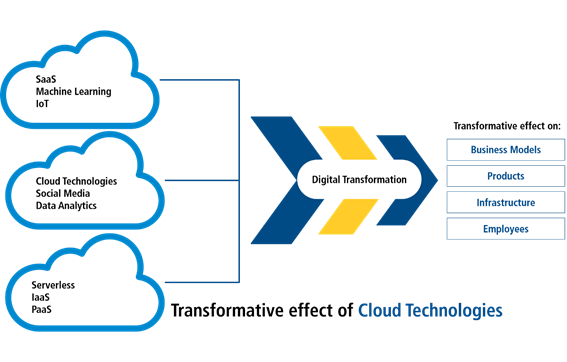
As a disruptive technology, the cloud enables decentralized and automated provisioning of computing power and storage, among other IT components. This flexibility and agility transform business operations, creating new opportunities for growth and expansion. Thus, cloud technologies possess the disruptive power to alter markets and business models. The imperative is to utilize the cloud optimally. It will help open the gates into the digital age. For such a high level of optimization, companies must embed cloud capabilities into everything—from the core business strategy to the production and sale of the product. In addition, companies will need to ensure people-process-technology collaboration at each node. The figure below illustrates the transformative power of the cloud in the key nodes of an organization:
The all-pervasive public cloud
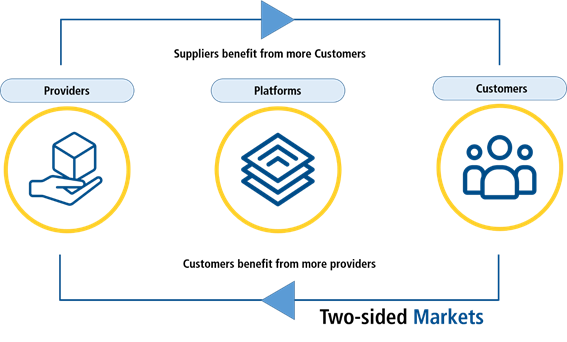
The pandemic gave wings to digitization, accelerating processes and technological advancements, particularly in IoT, blockchain, and AI. More recently, the ongoing buzz around metaverse and generative Artificial Intelligence (AI) has solidified the path for businesses to take to survive in the future. It is no wonder that we call this era the digital economy. After all, data is the new fuel. And several recently successful companies are digital platforms, such as Uber, Netflix, and Airbnb. By combining data with AI and Machine Learning (ML) algorithms, companies provide their end users customized services. This customization has elevated digital platforms to enormous economic power that can disrupt entire markets and industries. Digitization ensures that the value creation process moves from the brick-and-mortar model to the digital realm. Digital platforms act as a link between real-world production and the consumer. As a result, these platforms are increasingly claiming a larger pie of value creation in the cloud. The following are the prerequisites to a successful implementation of a digital platform on the cloud for the consumer world:- Sufficient amount of data (big data)
- Making sense of data (leveraging data)
- Market scenario from a need/gap perspective (market study)
Three levels of the cloud transformation journey
Every business or organization's cloud transformation journey is different and unique. Largely there are three different scenarios: Level 1Company's infrastructure model (transforming the infrastructure model) Level 2: Company's operating model (transforming the operating model) Level 3: Company's business model (transforming the business model)Level 1: Transforming the infrastructure model
In this transformation model, newer technology replaces the underlying infrastructure, associated middleware, databases, and operating system. The process involves describing and classifying the basic migration options per application into smaller quantum or modules. Engineers refer to it as the 5R model - Rehost, Replace, Refactor, Revise, and Rebuild. In Rehost, an application migrates from a dedicated/virtualized traditional IT environment to a cloud environment (Infrastructure-as-a-Service or IaaS). For instance, migration of SAP systems, since the provider forbids any changes to the application's architecture In Replace, a cloud-based Software-as-a-Service (SaaS) product completely replaces an application. For instance, replacing in-house email servers or office software with Office365. In Refactor and Revise, the application architecture changes according to business specifications. In Rebuild, the engineer rebuilds the application with identical business value leveraging the cloud-native technologies. Based on these 5R models, AWS has also developed its customized 6R model:- Rehosting corresponds to the Rehost.
- Re-platforming corresponds to the Refactor.
- Repurchasing corresponds to the Replace.
- Refactoring corresponds to the Revise.
- Retire: The application is abolished.
- Retain: The application remains on the original infrastructure.
Level 2: Transforming the operating model
The transformation of the operating model is the modernization of value creation, keeping the business model out of scope. For instance, food ordering apps still require physical touchpoints for food delivery at doorsteps. These companies can feel compelled by growing competition to modernize their value-creation processes, systems, and engagements. One such scenario is simplifying the ordering process for customers on the mobile application. In this model, the focus is on operations-relevant applications. Depending on the type of migration employed, new functions, scalability, and flexibility are seamlessly developed. Generally speaking, the potential benefits increase with the rise in automated IT. Features such as a microservice on the cloud avoid monolithic software, making the software application resilient and better at handling errors. Additionally, cloud-native apps help develop and introduce new features quickly.Level 3: Transforming the business model
An underlying presumption in all these strategies is that businesses, as social entities with established cultures, customs, routines, and worldviews, are not amenable to a disruptive change in a business model. The reason is that disruptive technologies do not change existing cultures, thought processes, and mindsets incrementally; they instead challenge the division of tasks, incentives, processes, and systems.A successful cloud transformation - summarized
Cloud technologies are certainly disrupting traditional IT. With the help of the cloud, companies can scale globally at zero marginal costs and develop and operate software more quickly and cost-effectively with DevOps. It is advisable to implement the right transformative public cloud strategy and journey to keep up with changing times, especially for startups and SMBs that exclusively rely on the new techniques.More Articles For You
 Outcreate Your Business
Outcreate with LTM
Outcreate Together

It’s time to Outcreate