AI-Assisted Operator Guidance for Improving Quality in Manufacturing Process
From Process Compliance to Manufacturing Confidence
Manufacturing quality is rarely lost in a dramatic failure. More often, it is lost in small decisions made too late, too differently, or without enough context. A subtle process drift, unnoticed material variation, or delayed operator response can quietly turn a recoverable batch into rework, scrap, or production delays.
The challenge for manufacturers today is not the lack of data. Modern plants already collect massive volumes of operational information through PLCs, historians, MES systems, and sensors. The real challenge is improving decision quality during execution — when the process is still recoverable and corrective action is still cost-effective.
AI-assisted operator guidance addresses this challenge by combining real-time process intelligence, explainable AI recommendations, and human expertise. It helps operators detect process drift earlier, take corrective action faster, and improve consistency across every shift and production line.
Why AI-Assisted Operator Guidance Matters
Traditional alarm-based manufacturing systems are designed to react after process limits are breached. By the time an alarm is triggered, quality loss may already have occurred.
AI-assisted guidance changes the decision window. Instead of reacting to failures, operators can identify and correct recoverable deviations before they become expensive quality events.
Where Manufacturing Quality Typically Erodes
Manufacturing processes are dynamic, and several factors contribute to variability:
- Material Variability: Raw material behavior changes from lot to lot, affecting process stability and product consistency.
- Timing and Sequence Sensitivity: Small differences in process timing or sequencing can create significant variation between batches.
- Manual Interventions: Operators often rely on experience-based decisions, which naturally vary across shifts and personnel.
- Tacit Expertise Gaps: Experienced operators recognize patterns and behaviors that standard SOPs cannot fully capture, creating knowledge silos within the organization.
The result is familiar across many manufacturing environments: increased rework, inconsistent batches, delayed release cycles, over-processing, and recurring investigations.
These are not simply process inefficiencies — they are economic decision points where margins are quietly lost.
What Effective AI Guidance Should Deliver
The objective of AI-assisted guidance is not to add another dashboard or layer of alarms. The goal is to improve operator decisions while the process is still recoverable.
An effective AI guidance layer should provide:
- Process-State Recognition
Understand the actual process condition in real time — not just the planned workflow step. This allows operators to compare the current batch against known-good production patterns.
- Early Divergence Detection
Identify meaningful process drift before traditional alarm thresholds are breached. Subtle shifts in torque, energy accumulation, temperature behavior, or rate-of-change trends can often signal future quality problems long before alarms activate.
- Smart Next-Best Actions
Provide operators with clear, actionable recommendations in operational language, such as:
- Extend mixing time
- Reduce RPM
- Hold a process stage for verification
- Monitor torque gradient stabilization
The guidance should be practical, prioritized, and immediately executable.
- Explainable Recommendations
Operators need to understand why the AI is recommending an action and the quality impact it is intended to prevent. Transparency builds trust and improves adoption on the plant floor.
- Expert Knowledge Preservation
AI-assisted guidance captures and scales the reasoning patterns of experienced operators, making best-practice decision-making available across every shift, site, and workforce transition.
Our Solution
Integrated Solution: AVEVA MES + SLM
A modern AI-assisted operator guidance solution combines manufacturing execution systems, real-time visualization, historian data, and edge AI intelligence into a unified operational framework.
Key technologies powering the solution include:
- AVEVA MES
- AVEVA InTouch OMI
- AVEVA Historian
- Edge-based Small Language Models (SLMs)
Why Edge AI Instead of Cloud-Only Models?
Deploying AI at the edge provides several operational advantages:
- Sub-second inference latency
- No dependency on continuous cloud connectivity
- Full data sovereignty for sensitive plant operations
- Lower operational costs compared to large cloud-hosted AI models
This allows manufacturers to run predictive intelligence directly within plant operations while maintaining operational resilience and compliance.
End-to-End Operational Flow
The integrated architecture follows a continuous signal-to-action workflow:
1. Plant Floor Signals
Real-time data is collected from PLCs and equipment sensors, including:
- Motor torque
- RPM and shear rate
- Batch temperature
- Specific energy input
- Solid-liquid ratio
- Torque slope trends
2. Data Backbone & Historian
Operational data flows through OPC-UA and AVEVA infrastructure into the historian environment for contextual processing and trend analysis.
3. Edge AI / SLM Inference
The edge AI model continuously evaluates process behavior in near real time, predicting viscosity trends and identifying early process drift.
4. Operator Guidance Interface
Using AVEVA InTouch OMI, operators receive:
- Live KPIs
- Risk scoring
- Trend overlays
- Explainable AI recommendations
- Accept / Override controls
5. MES Decision Logging
All operator actions and AI recommendations are logged into AVEVA MES for auditability, compliance, and traceability.
6. Continuous Learning Loop
Batch outcomes feed future model retraining, allowing the guidance system to improve continuously over time.
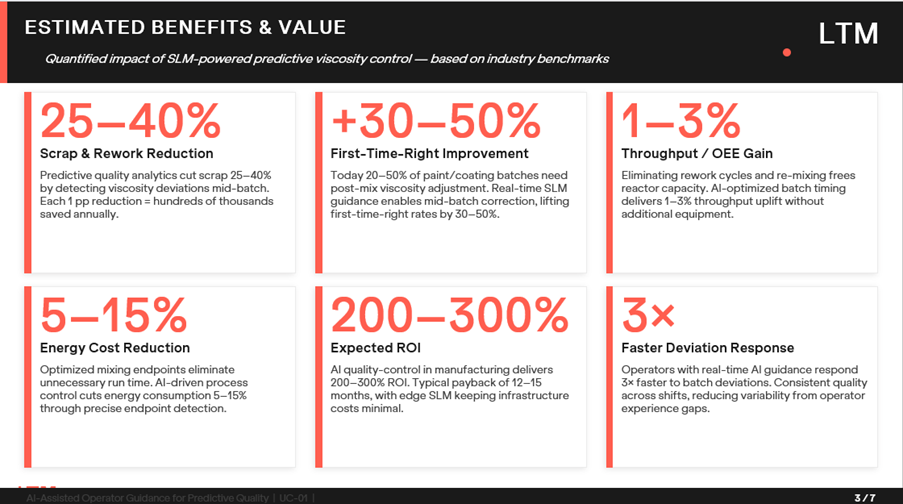
Business Impact of AI-Assisted Guidance
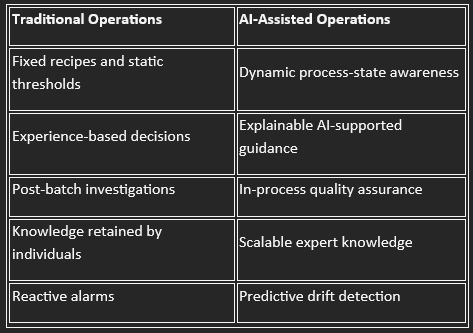
The Operating Model Shift
AI-assisted guidance represents more than a technology upgrade. It is a shift in manufacturing operations:
The next improvement in manufacturing quality will not come from adding more alarms or generating more reports. It will come from enabling better decisions during execution.
Manufacturers that operationalize AI-assisted guidance effectively will improve quality consistency not because they collect more data, but because they act on the right signals earlier, faster, and with greater confidence.
AI does not replace operator judgment. It strengthens it, scales it, and delivers it precisely when it matters most.

Dhruv Gheewala
 Outcreate Your Business
Outcreate with LTM
Outcreate Together

It’s time to Outcreate