Business Challenges
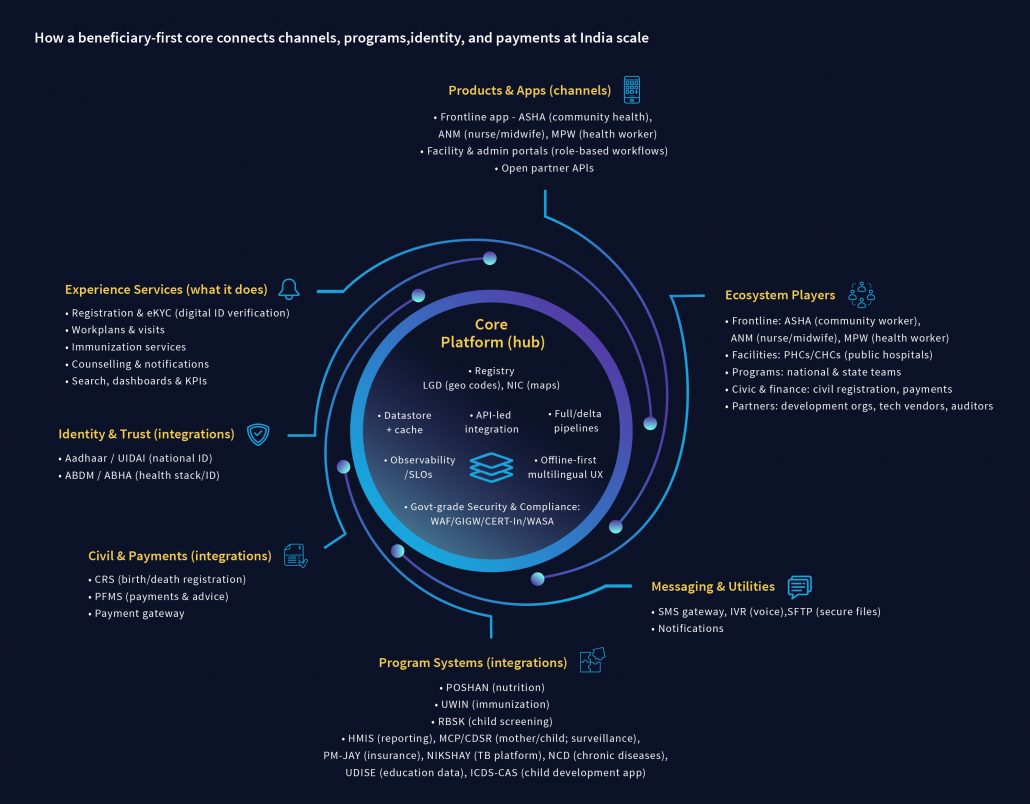
The client needed a national-scale RCH platform that could reliably support state rollouts, frontline workflows, and stringent regulatory requirements. Existing technical debt, fragmented records, and low-connectivity field conditions created both operational risk and measurable program delivery gaps that threatened service continuity, targeting accuracy, and donor confidence.
National-scale service delivery requirements
The platform had to support 10–15 lakh daily logins, ~5,000 concurrent users, and ~300 transactions per second (TPS) across 250k+ facilities and 1M+ providers. Failing to meet these performance targets would disrupt care delivery, reduce system adoption, and undermine program reach during peak outreach and immunization drives.
Fragmented legacy data and duplicate records
State-specific versions of the prior system produced inconsistencies and duplicates, preventing a single beneficiary view. This fragmentation reduces targeting accuracy, drives inefficient resource allocation, and weakens the ability to produce auditable program reports for funders.
Interoperability across a complex ecosystem
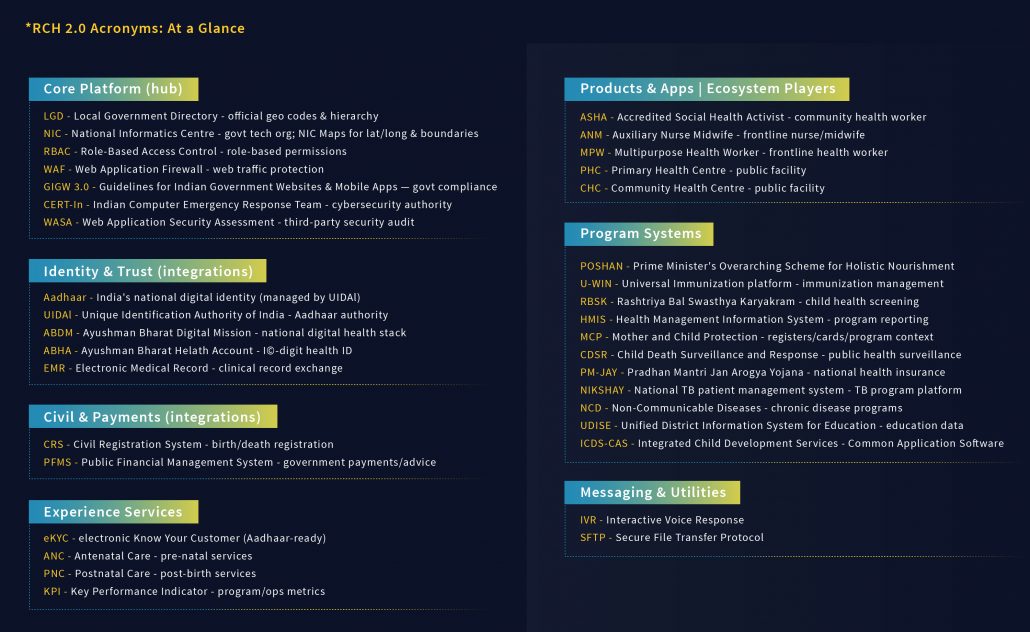
The solution needed to integrate with 15+ health and non-health systems (for example, national health IDs, immunization, nutrition, and payments). Poor integrations require manual reconciliation, delay care coordination, and block seamless end-to-end beneficiary services.
Trust, privacy, and compliance obligations
The platform must protect sensitive Personally Identifiable Information (PII) and Sensitive Personal Information (SPI) and satisfy repeated third-party security assessments and government certifications. Any lapse could lead to regulatory penalties, loss of stakeholder trust, and constrained funding or program approvals.
Field realities and accessibility constraints
Frontline workers operate in low-connectivity environments and require mobile-first, role-based experiences. Without these capabilities, adoption drops, data quality suffers, and critical services fail to reach the most vulnerable populations.