Operational Excellence for Oracle AI Database@Azure Monitoring: Delivering an End‑to‑End Solution with Azure-Native Observability


A Deep Dive into the Architecture for Oracle AI Database@Azure Monitoring
As enterprises expand across diverse cloud environments, observability is no longer just about collecting metrics. It becomes the ability to piece together a clear, unified operational storyline. For Oracle Database teams running mission‑critical workloads on Azure, the challenge is not a lack of tools, it is how to retain the depth of Oracle-native insights while fully leveraging Azure’s monitoring ecosystem.
This is where Oracle AI Database@Azure monitoring begins to evolve from a technical requirement into a strategic capability.
August 2025: A Meaningful Shift in Monitoring Practices
In August 2025, Oracle and Microsoft introduced native Azure Monitor integration for Exadata infrastructure and VM clusters.
This was not just another metrics export. It marked a deeper architectural integration, where Exadata logs, events, and metrics could flow directly into Azure Monitor. For the first time, teams could build unified dashboards that combined Azure service telemetry with Oracle database operational data in a meaningful way.
It fundamentally changed how Oracle AI Database@Azure monitoring could be approached, moving from siloed visibility to a more connected, end-to-end view. In this blog, I will walk through how to leverage this capability to build a comprehensive observability solution.
The Three-Tier Monitoring Architecture
To build effective observability, it helps to think in layers. Oracle AI Database@Azure monitoring typically operates across three distinct but interconnected tiers, each contributing a different dimension of insight.
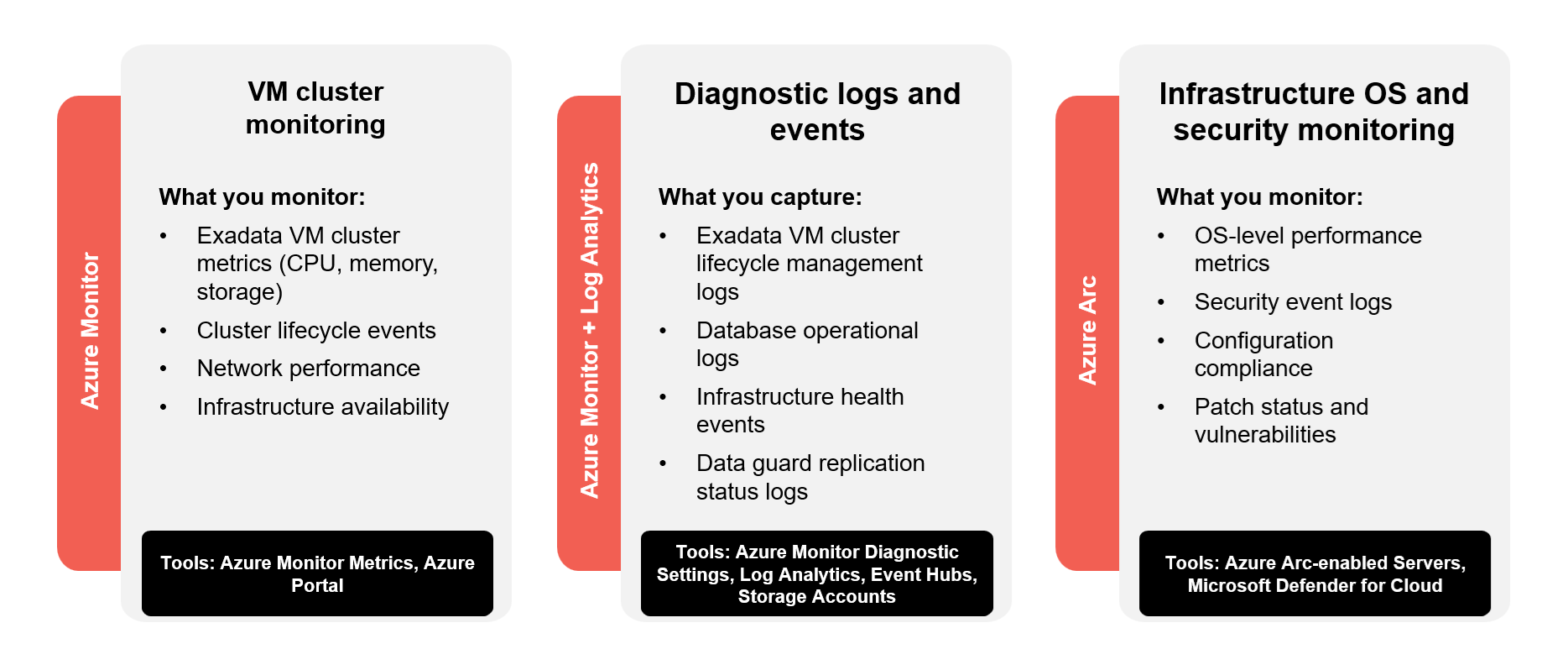
Figure 1: Three distinct interconnected layers
Customer Scenario: Global Insurance Provider Group–Oracle Database on Azure
To bring this to life, consider a scenario commonly seen across large enterprises, including implementations delivered by system integrators like LTM.
In this case, a global insurance and reinsurance provider, known for its expertise in run-off liability management, was running high-volume OLTP workloads with strict operational requirements. These included ultra-low latency, a strong high-availability and disaster recovery posture, regulatory-compliant logging, and deep visibility into database health and performance.
The organization had recently migrated from on-premises Oracle Database to Oracle AI Database@Azure, adopting:
- Exadata X11M shapes on Azure powered by AMD EPYC processors.
- Oracle Data Guard for disaster recovery across regions
- Azure Private DNS and Azure Firewall for secure access
- Azure Monitor and Log Analytics for observability
Given the sensitivity of financial workloads, the priority was clear: build a highly automated, Azure-native observability model that could centralize telemetry across compute, network, storage, and Exadata database nodes.
Monitoring and Observability Using Azure-Native Services
The solution relied on a stack of Azure-native services designed to work together seamlessly. Below is the Azure-native services stack used:
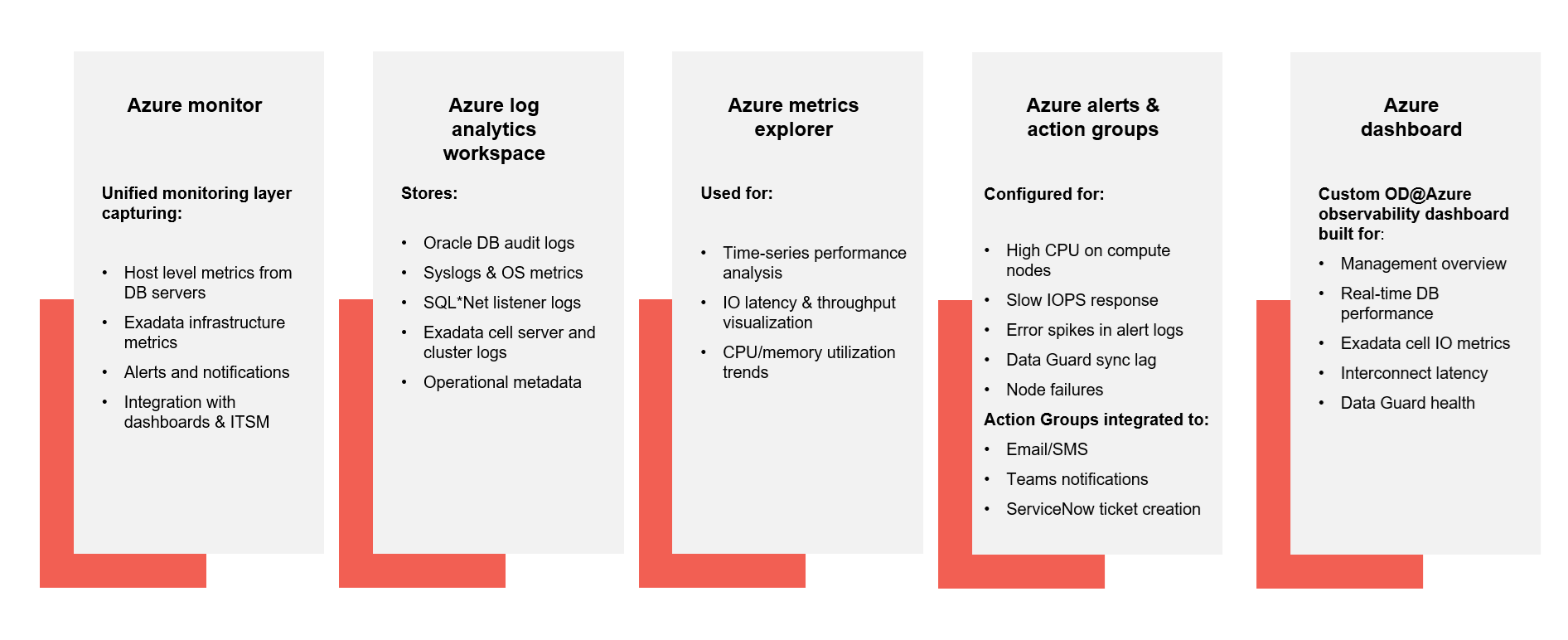
Figure 2: Azure-native services stack
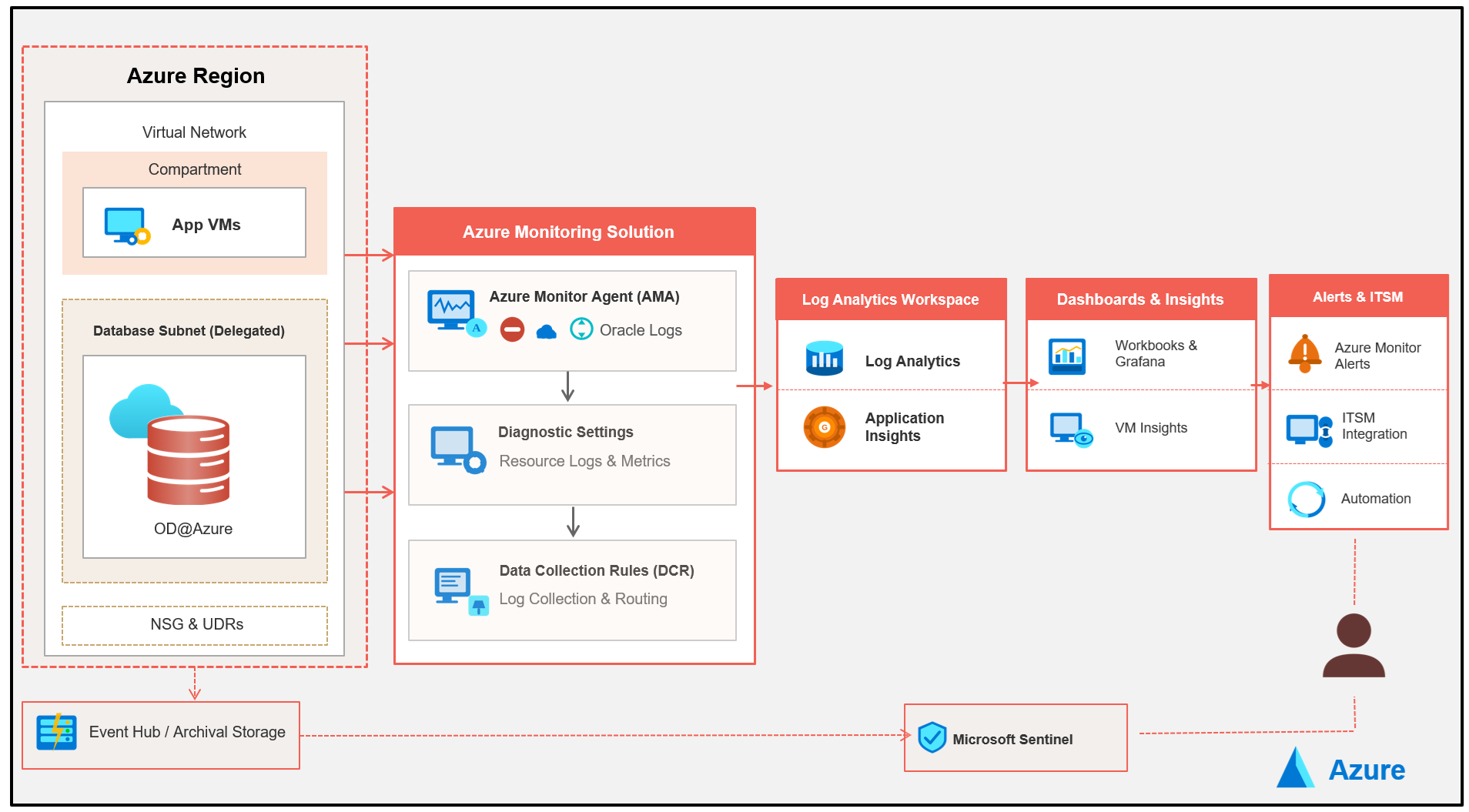
At its core, the architecture followed Microsoft’s Cloud Adoption Framework (CAF) and positioned Azure Monitor as the central observability layer.
Monitoring signals including logs, metrics, and events from application virtual machines, Oracle Exadata database nodes, and Azure platform services were collected and processed into a unified pipeline. These signals were then stored, analyzed, and visualized using Azure-native tools, enabling faster and more contextual decision-making.
An important component of this setup was Azure Log Analytics for Oracle, which enabled deeper analysis of database logs alongside infrastructure telemetry. This allowed teams to correlate database-level events with system-level signals, significantly improving troubleshooting and root cause analysis.
Additionally, Microsoft Sentinel was integrated to enhance threat detection and security correlation, leveraging Azure Log Analytics for Oracle data to provide a more comprehensive security posture.
Integrating AutoDB+ with Cloud-Native Monitoring
To extend observability further, organizations often layer in intelligent platforms such as AutoDB+.
AutoDB+ is an advanced database automation and observability platform designed to enhance database health monitoring, predictive analytics, anomaly detection, and automated remediation.
Rather than replacing native cloud monitoring, it complements it with deeper DBspecific intelligence. What does this look like in practice:
- Correlates signals across layers by bringing together infrastructure, database, and SQL-level metrics into a single view
- Delivers richer diagnostics, going beyond standard platform insights to pinpoint root causes faster
- Applies AI/ML-driven anomaly detection to identify performance deviations early
- Enables auto-healing through automated remediation workflows
- Extends observability across hybrid estates, ensuring consistency beyond a single cloud environment
How the Insurance Leader Improved Oracle AI Database@Azure Operations
With this architecture in place, the organization was able to significantly improve how it managed its Oracle AI Database@Azure environment.
Visibility became centralized across all Oracle AI Database@Azure components, eliminating the need for separate Oracle tooling for infrastructure-level monitoring. Troubleshooting became faster, as teams could correlate Oracle alert logs with compute and storage events using KQL queries.
Predictive insights also improved. Azure Monitor baselines, combined with machine learning models, helped identify unusual I/O patterns before they escalated into incidents.
Operational workflows became more streamlined as well, with integrations across ServiceNow, Microsoft Teams, and ITSM systems enabling automated alerts and responses.
The cumulative impact was substantial. Manual overhead reduced significantly, and dashboards and query-driven insights cut troubleshooting effort by nearly 40%.
Conclusion
Oracle AI Database@Azure brings together the performance of Oracle Exadata and the operational flexibility of Azure into a unified platform.
By leveraging Azure Monitor, Log Analytics, dashboards, and alerts, enterprises can achieve deeper observability, predictive insights, and more coordinated operations. The ability to unify infrastructure and database telemetry, especially through capabilities like Azure Log Analytics for Oracle, transforms how teams manage and optimize their environments.
This approach does more than improve monitoring. It simplifies lifecycle management and strengthens governance, security, and compliance. Ultimately, it positions Oracle AI Database@Azure not just as a migration pathway, but as a foundation for modernization.
 Outcreate Your Business
Outcreate with LTM
Outcreate Together

It’s time to Outcreate