From Data Ocean to Decision Fabric: Building the Intelligent Utility Enterprise

Modern utility organizations operate in one of the most data-intensive environments of any industry. Customer information, metering data, billing transactions, asset records, workforce activities, operational technology signals, and financial information generate vast amounts of data across the enterprise.
Why Utilities Need a New Operating Model
Utility enterprises are navigating increasing complexity driven by smart metering, renewable energy integration, distributed energy resources, electric vehicles, and intelligent grid technologies. At the same time, rising customer expectations, regulatory demands, and infrastructure modernization efforts are putting additional pressure on operations.
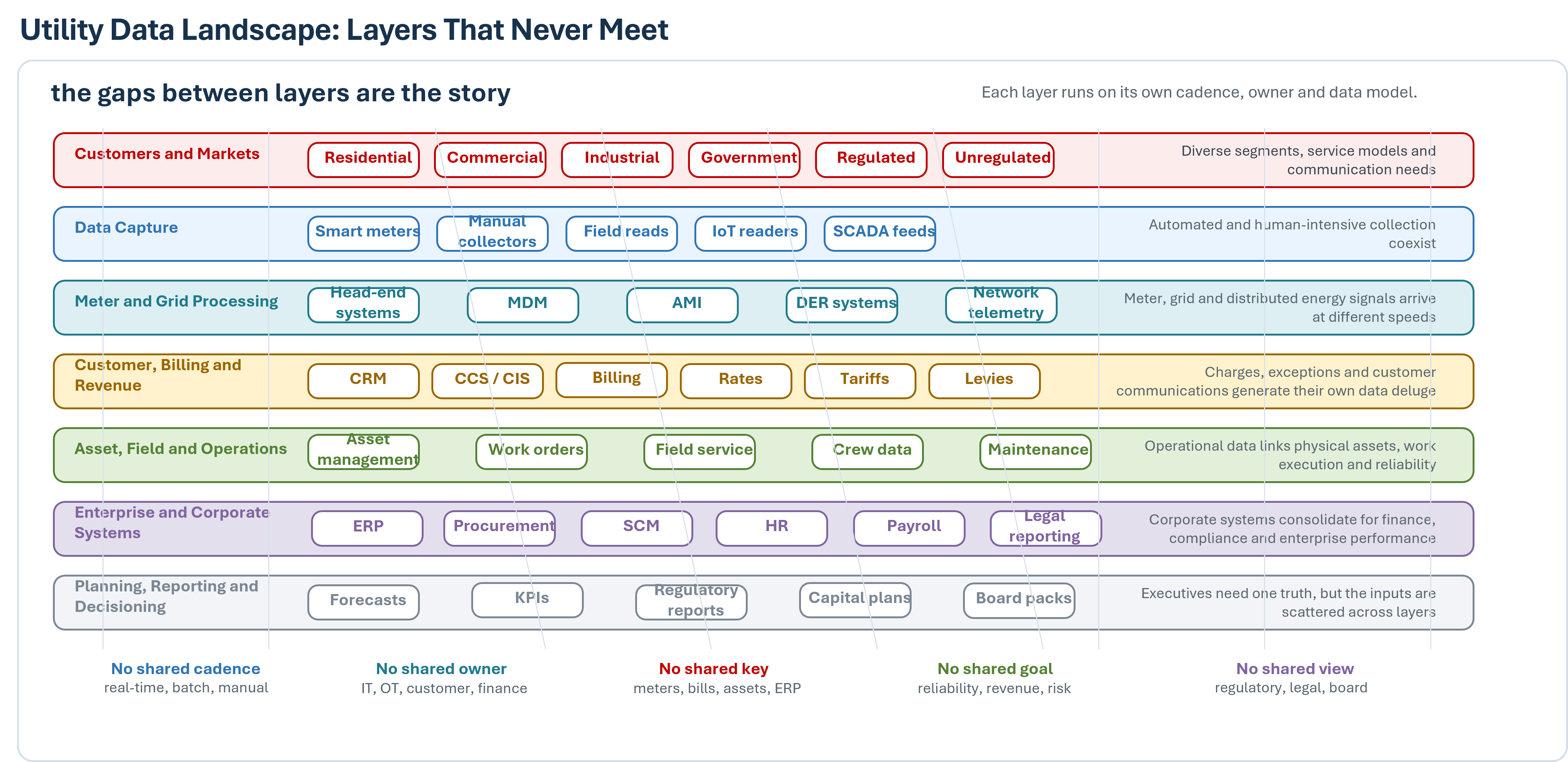
To keep pace, utilities have invested heavily in integration platforms, analytics, cloud services, and data ecosystems. Yet information often remains fragmented across billing, asset management, field service, and ERP systems, limiting enterprise-wide visibility.
As a result, utilities have more data and technology than ever before but still struggle to make connected, enterprise-level decisions. This is driving a shift from traditional system integration toward operational integration, where information flows seamlessly across functions to support a more connected and intelligent enterprise.
A Connected Utility Enterprise for Holistic Operations
The next step in digital evolution goes beyond adding more applications or reports for a utility digital transformation. The real opportunity lies in creating a Connected Utility Enterprise, where business capabilities are seamlessly linked through a shared digital foundation. This requires utilities to move beyond incremental improvement and conventional transformation approaches. It demands an Outcreate mindset: reimagining how customer, operational, workforce, asset, and financial decisions are connected to create entirely new levels of enterprise intelligence and business value.
How to Build a Connected Utility Enterprise
The future utility enterprise should be designed around capabilities rather than applications. Applications may evolve, be replaced, or modernized over time, but core business capabilities remain constant.
These capabilities include:
• Understanding and serving customers effectively
• Managing consumption and meter-to-cash processes
• Operating and maintaining the grid
• Managing asset reliability and lifecycle performance
• Mobilizing and optimizing workforce execution
• Delivering capital infrastructure programs
• Supporting enterprise operations through finance, procurement, compliance, and governance
• Enabling better operational and strategic decision-making
For these capabilities to operate as a connected enterprise, utilities require more than technical integrations between systems. They require a shared digital foundation capable of providing governance, security, common data services, workflow orchestration, analytics, automation, and enterprise-wide visibility.
Such a foundation allows every business event to be understood within a broader organizational context.
For example, a transformer failure should not be viewed solely as an asset event. It may affect customer experience, service reliability, workforce deployment, regulatory compliance, revenue recovery, inventory planning, and future capital investment decisions. Similarly, a customer billing inquiry may involve meter events, outage history, field service activities, and network conditions beyond traditional customer and billing systems.
This capability-driven approach towards utility digital transformation naturally aligns with Oracle's integrated utility vision.
Oracle's utility ecosystem combines customer management, metering, billing, asset management, field service, capital project management, enterprise resource planning, analytics, and cloud infrastructure into an interconnected operating model. Instead of treating customer experience, asset performance, workforce productivity, financial outcomes, and operational resilience as separate objectives, they become connected elements within a common enterprise fabric.
Customer interactions influence revenue outcomes. Revenue forecasts influence planning decisions. Planning decisions affect capital investments. Capital investments impact asset health and grid reliability. Asset performance directly influences customer experience.
By connecting these relationships, utilities create a common enterprise context across customer operations, network performance, workforce management, project delivery, and financial management.
The Need to Scale AI
An equally important outcome of this connected foundation is the ability to scale Artificial Intelligence (AI) effectively.
AI derives its value not merely from transactions but from context. The broader the context available, the greater its ability to identify patterns, anticipate outcomes, recommend actions, and automate decisions.
When customer information, consumption patterns, asset health, workforce activities, operational events, and financial data exist within a common operating model, AI can deliver enterprise-wide intelligence rather than isolated functional insights.
A customer complaint can be evaluated against outage events, meter readings, billing history, and field activities. Asset performance issues can be assessed alongside customer impact, workforce availability, regulatory obligations, and investment priorities. Severe weather events can trigger coordinated responses across outage management, customer communications, inventory management, field crews, and executive reporting.
Leverage Oracle’s AI-enabled Architecture
This is where Oracle's AI-enabled architecture becomes especially relevant for utility digital transformation that builds a connected utility enterprise. Oracle integrates AI capabilities across infrastructure, data services, applications, analytics, and business processes, enabling organizations to embed intelligence directly into utility operations rather than treating AI as a separate technology layer.
The result is a connected utility enterprise capable of moving beyond visibility toward prediction, recommendation, and autonomous action.
This connected foundation is the starting point, not the destination. A companion perspective, From Connected Systems to Intelligent Utility Operations, explores what happens next — how utilities translate a connected foundation into day-to-day intelligent operations and enterprise-scale decision-making.
Typical Barriers to a Connected Utility Enterprise
While the vision of an intelligent utility enterprise is compelling, organizations face several practical barriers in realizing it.
Many utilities operate complex environments spanning Oracle Cloud applications, Oracle E-Business Suite, JD Edwards, PeopleSoft, custom-developed solutions, operational technology platforms, and fragmented data landscapes. Organizational silos often exist between operational teams focused on grid performance and enterprise teams responsible for finance, procurement, compliance, and planning. In many cases, AI initiatives struggle due to limited enterprise context, inconsistent data foundations, and disconnected business processes.
A Structured Transformation Approach to Overcome Barriers
Overcoming these challenges requires a structured transformation approach, one that pairs Business AI with a disciplined transformation methodology built around sensing opportunity, shaping the target state, standing up capability, and sustaining outcomes. Supported by a growing library of AI agents across industries and process domains, this approach introduces intelligence into customer operations, billing processes, asset management, workforce productivity, capital projects, and enterprise services.
Complementing this are modern AI data platform foundations, modernization accelerators, reusable assets, and AI-enabled delivery frameworks that help utilities modernize existing landscapes while reducing transformation complexity and risk. Together, these approaches demonstrate how organizations can move from fragmented systems toward connected intelligence without disrupting ongoing business operations.
Conclusion
The future of utility transformation is not simply about cloud adoption, dashboards, or AI. It is about evolving from fragmented systems to connected capabilities, enterprise intelligence, and coordinated action.
A Connected Utility Enterprise creates a shared digital foundation that brings customer, asset, workforce, operational, and financial information into a common business context. This enables greater visibility, stronger governance, and scalable AI-driven insights and automation.
Ultimately, the goal is not merely to digitize existing utility operations but to Outcreate them. By connecting people, processes, assets, data, and AI within a common enterprise fabric, utilities can unlock new levels of agility, resilience, and innovation that are difficult to achieve through incremental improvements alone.
Utilities that embrace this shift will move beyond operational efficiency to become more adaptive, informed, and responsive organizations. In an increasingly complex environment, the competitive advantage will come not from having more data, but from connecting it into a decision fabric that enables the enterprise to learn, adapt, and act swiftly.
 Outcreate Your Business
Outcreate with LTM
Outcreate Together

It’s time to Outcreate