
Sunshine
Organizations today generate and consume data at an unprecedented scale. lobal data volumes are growing exponentially, and the velocity at which diverse datasets are produced far outpaces what legacy data warehouses and on-premises systems were built to handle. Traditional on-prem systems, analytics platforms like SAS, and legacy ETL tools like SSIS and Alteryx while once reliable, now create bottlenecks, siloed data estates, mounting technical debt, and rising operational costs.
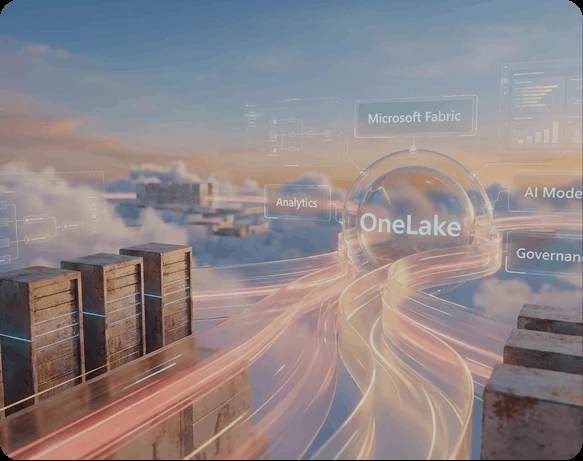
This growing gap between data demand and infrastructure capability is making data modernization a cornerstone of every digital transformation initiative. Modern platforms like MS Fabric offer a unified, end-to-end analytics experience, combining data integration, enterprise storage on OneLake, AI models, real-time analytics, and centralized governance within a single managed SaaS platform.
However, migrating from legacy environments to these modern platforms is often complex, resource-intensive, and unpredictable, and that's exactly the problem Sunshine solves.
Sunshine, LTM's proprietary data modernization accelerator, takes the complexity out of this journey, transforming what traditionally takes months into weeks through an automation-first, AI-powered approach that delivers predictable, cost-effective outcomes.
Our Framework
Sunshine provides end-to-end automation in migration from on-premises to Azure, right from pre-migration strategy to post-migration optimization.
Helping You Outcreate Data Modernization
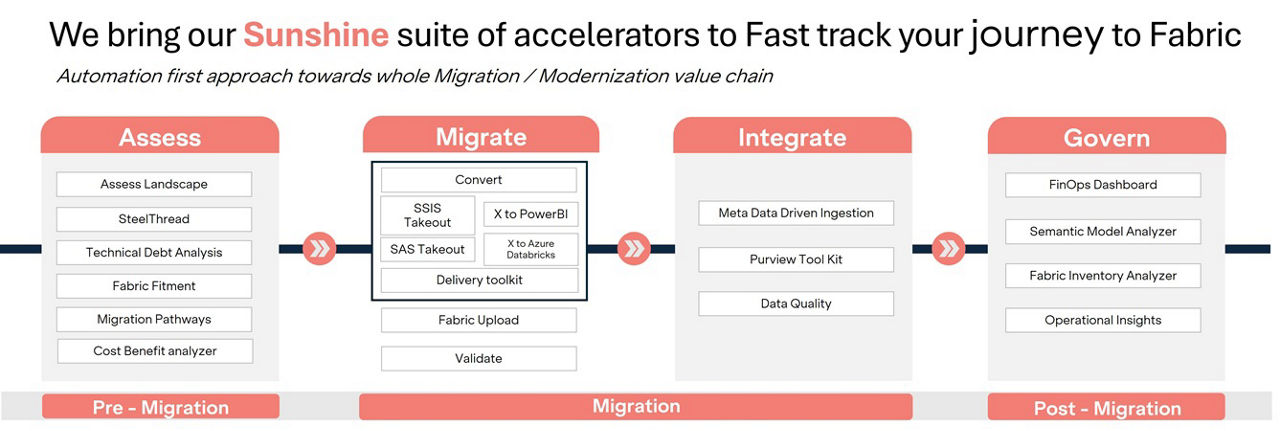
From discovery to post-migration governance, Sunshine Accelerator's suite of 18+ purpose-built utilities automates every phase of your modernization journey, reducing timelines, cutting costs, and ensuring zero-compromise migration quality.
a. Assess landscape: Scans and catalogs your legacy data estate, data assets, ETL pipelines, and up/downstream dependencies to build a complete migration blueprint.
b. Steelthread: Retrospective data lineage tool with support across 15+ tools to map dependencies and assist with migration planning with 40–60% process improvement
c. Technical Debt Analysis: Identifies technical and platform debt such as redundant logic, outdated frameworks, inefficient code, and aging infrastructure, ensuring migration is lean, intentional, and free of inherited inefficiencies.
d. Cost Benefits Analyzer: Estimates the total cost of ownership (TCO) benefit of migrating to MS Fabric
a. Convert: Automatically transforms legacy code into Fabric-compatible formats using Gen AI-powered conversion
- SSIS takeout: Gen AI-based utility to automate SSIS package analysis, migration, and code conversion with 30–50% effort automation
- SAS takeout: Utility-driven automation to migrate SAS workloads to modern data platforms with 40–60% effort automation
- X to PowerBI takeout: Utility-driven migration from any BI to Power BI with 30–50% effort automation
- X to Azure Databricks: Accelerates migration from over 10 legacy platforms to Azure Databricks with up to 50% productivity gain
- Delivery toolkit: Pre-built frameworks and semi-automated scripts to fast-track your Fabric environment setup
b. Fabric Upload: Deploys converted code and data assets into the target Fabric environment seamlessly
c. Validate: Performs automated reconciliation to ensure migrated outputs match legacy system results with zero data compromise
a. Meta Data-driven Ingestion Framework: Automates data ingestion using metadata configurations via readily deployable ADF pipeline templates with 30–50% effort automation
b. Purview Toolkit: Integrates Microsoft Purview for automated data cataloguing, compliance enforcement, and lineage tracking across your Fabric estate
c. Data Quality Qualifer: Semi-automated DQ framework to continuously gauge the technical and business quality of your data
a. FinOps: Enables cloud cost governance through spend visibility, usage optimization, and financial accountability, with 20–30% TCO reduction
b. Semantic Model Analyzer: Analyzes and optimizes semantic models for reporting performance and accuracy
c. Fabric Inventory Analyzer: Catalogs and monitors your Fabric estate for resource optimization and capacity planning
d. Observability: Delivers real-time visibility into pipeline health, usage patterns, and platform performance
Key Benefits
Smart Validation
Cost Reduction
Automation
Comprehensive Governance

 Outcreate Your Business
Outcreate with LTM
Outcreate Together

It’s time to Outcreate