Business goals and objectives
Humanitarian aid operations often face significant challenges like delays and resource constraints, making it harder to respond quickly and effectively during crises. Traditional methods can be slow due to fragmented data that requires greater manual effort, and are also prone to human error, limiting the scale and impact of relief efforts. Moreover, a lack of humanitarian funding often exacerbates these challenges.
In today’s interconnected world, the complexity and frequency of humanitarian crises require a new approach—one that is agile, data-driven, and scalable. This is where innovative technologies like Gen AI can make a profound difference. By leveraging tools such as AI-powered chat interfaces, automated data processing, and predictive analytics, humanitarian organizations can streamline their operations, accelerate decision-making, and improve service delivery to those in need.
When response time needs to improve, real-time insights, streamlined communication, and intelligent automation becomes more critical than ever. By embracing Gen AI, humanitarian organizations can enhance their operational efficiency, future-proof their efforts, and, most importantly, help more people in need, with greater speed and precision.
Challenges
Our client faced significant challenges in delivering timely and accurate information to its large field force, which constituted more than 90% of its employee base. The lag in policy information, interpretation, and decision-making impacted millions of lives. This delay was primarily due to multiple revisions in policy documentation over the years and references to myriad sections and annexures. Some of the challenges included:
- Historical context dependency: Preventing timely updates to documents.
- Large document sets: Covering global policies with complex interconnections.
- Major SME dependency: Extracting the correct context from extensive documentation.
- Siloed information: Information was fragmented across multiple documents and annexures.
- Specific terminology and acronyms: Making it difficult to navigate and interpret documents.
- Separate document libraries: Storing use case-specific documents that were difficult to search and navigate.
LTM’s solution
LTIMindtree developed a scalable Gen AI solution, that leveraged Azure OpenAI and other AI services, to enhance information retrieval and operational efficiency for the client. It provided structured information and assistance, fast-tracking fast tracking services that impact human lives services. Key elements of the solution included:
Conversational AI & Gen AI Enablement
- Conversational AI: For efficient knowledge management and real-time insights
- Center of excellence: Improved the GenAI solution’s accuracy using innovative technology
- Feedback loop mechanism: With Microsoft Azure OpenAI product team to improve search accuracy
Real-time Insights and Decision Support
- Real-time insights and decision support: Improved data accuracy and reliability for decision-making
- Telemetry-enabled solution: For real-time usage monitoring
- User queries: Focused search and consume data mechanism to eliminate delays
Dynamic Data Handling and Research
- Multilingual data: Both in terms of agents and solutions
- Auto indexing: Reflecting any changes in documentation immediately
- Research team setup: Explored product capabilities and enabled upcoming requirements
As a chat platform, the solution is multipurpose and has been adopted by various other functions like the HR, finance, external relations, innovation, and IT teams to get an in-depth understanding of spend patterns anomalies and basic policy Q&A, respectively. The beauty of the solution is that it has been built with a customer-first mindset with emphasis on having high quality data in place which is key for success of any chat data platform.
To successfully transition the five Generative AI proof of concepts (POCs) into a production environment, the team adopted an Agile delivery model structured around 32 sprints, each spanning two weeks. This iterative approach enabled continuous development, testing, and refinement of features, ensuring alignment with evolving business requirements and technical feasibility.
Throughout the 64-week timeline, cross-functional collaboration between application architects, program managers, data scientists, Gen AI engineers, infra developers, and DevOps teams facilitated seamless integration of Gen AI capabilities into the enterprise ecosystem.
Regular sprint reviews and retrospectives ensured transparency, adaptability, and incremental value delivery, ultimately culminating in a robust, scalable, and production-ready Gen AI solutions for each BU.
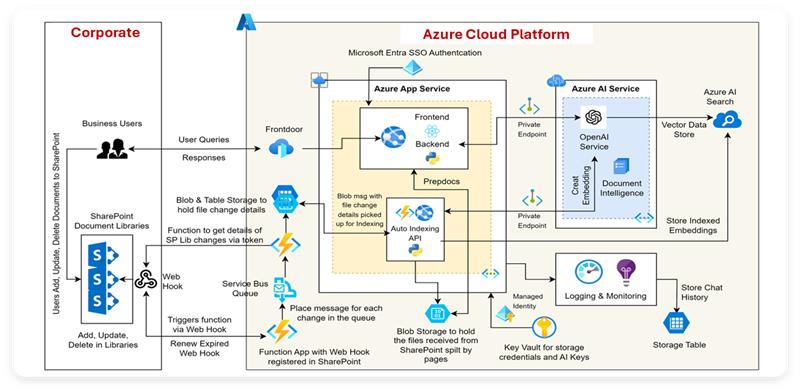
Tech stack
The solution was architected using a comprehensive and enterprise-aligned technology stack, tailored to fit the business environment and methodologies.
Python: Quart Web Microframework
Azure OpenAI: GPT-3.5/4, Cognitive Search, Semantic Search, Form Recognizer
Microsoft: Entra ID, 365 Services, SharePoint Online, Power Automate
Azure: Web Apps, DevOps
Business outcomes
The implementation of LTIMindtree’s Gen AI solution has improved the client’s operational efficiency with significant benefits:
- 30% faster search: Policy Interpretation and Document retrieval process saw huge efficiency
- 40% faster decision-making: Data analysis and augmented data insights enabled faster and improved decision-making.
- 290K hours saved per year: Saving manual hours enabled a more efficient and timely response towards human lives and communities.
- 45% helpdesk ticket reduction: Reduction in support for complex queries, responding to complex cases, queries, emails, and recurring daily questions.
Contact Us
 Outcreate Your Business
Outcreate with LTM
Outcreate Together

It’s time to Outcreate