The Future of Program Delivery: From Human Armies to AI Agents
The Future of Program Delivery: From Human Armies to AI Agents
November 19, 2025
By: Sachin Kamath, Head of Delivery – (AI Services) BlueVerse, LTM
Program delivery has relied on having the right workforce—project managers, analysts, and teams—navigating complex workflows using spreadsheets, meetings, and status decks for decades. This structure worked until it didn’t.
As transformation programs expanded in scale and speed, this human-intensive model began to strain under its own weight: there were too many handoffs, too little continuity of context, and a limited capacity to adapt in real time. And the focus was always on the optics.
Today, automation and analytics have reached their ceiling. They make individual processes faster but don’t change the operating model governing delivery. Program managers still chase status updates, stakeholders, and governance metrics.
The result: large initiatives, such as cloud migrations, legacy modernizations, and ERP transformations, continue to overrun timelines and budgets despite the use of improved tools and dashboards.
The next phase of evolution is not more automation. It’s intelligent agentic orchestration. AI agents, designed to reason, decide, and collaborate, are beginning to handle coordination, risk tracking, reporting, and quality checks as part of a unified program environment. What once required dozens of people to monitor fragmented tools can now be managed through a network of intelligent agents that communicate, learn, and act autonomously.
The most forward-thinking enterprises aren’t asking how to automate program delivery anymore; they’re asking how to architect it as a living agentic system. When programs start behaving like adaptive organisms, reacting to situations, learning from every project, rebalancing resources, predicting and managing bottlenecks before they happen, that’s when transformation becomes continuous rather than episodic.
The next phase of evolution is not more automation. It’s intelligent Agentic orchestration.
In the sections ahead, we explore this intelligent agentic orchestration and a future where humans and AI agents collaborate to build self-delivering programs.
How Automation Evolved into Intelligent Agentic Orchestration
Automation has been part of program delivery for some time; automated reports, scripted workflows, and bots that execute routine actions. However, rule-based automation has its own gaps. The visual below is a representation of the gaps:
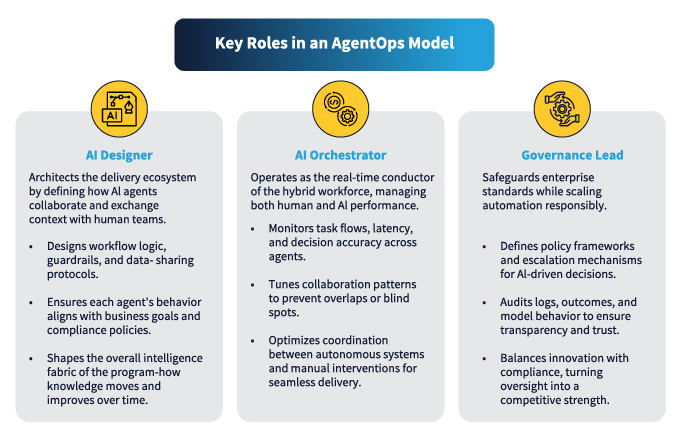
The next evolution is intelligent agentic orchestration, where the system understands, reasons, and adapts. Instead of humans coordinating between disconnected tools, AI agents now interpret context, predict risks, and align workstreams in real time.
In this model:
- Systems act on real time triggers for task completions, approval workflows, or threshold breaches, automatically generating reports or routing updates to the next team. This speeds up coordination and creates a more contextualized response to the needs of the program.
- Agentic orchestration learns from changing variables like shifting dependencies, resource bottlenecks, or delivery delays, and adjusts dynamically. For instance, reassigning underutilized resources or reprioritizing tasks when critical paths slip.
- Humans supervise strategy, judgment, and exceptions instead of transactions. For example, program leaders focus on validating trade-offs between budget, risk, and value delivery rather than chasing task updates.
This shift transforms the delivery ecosystem from static workflows to adaptive networks, where tasks, dependencies, and outcomes are continuously optimized through machine learning feedback loops.
Many enterprises think they’ve achieved AI maturity when they automate dashboards or workflows. In reality, that’s still process automation. Actual orchestration starts when the system can reason about outcomes, and that’s where program delivery becomes a competitive advantage, not a cost center.
Types of Agents That Can Actually Deliver Programs
As AI moves from pilots to production, delivery leaders realize that not all agents create equal value. The real breakthrough comes from using coordinated agent types, clusters of AI entities designed to manage specific stages of program delivery while sharing a common context. You may also consider custom-built agents that serve the purpose for only a specific program.
In most enterprise transformations, some types of agents that are proving consistently valuable.
- Discovery Agent
Scans legacy systems, maps schemas and dependencies, flags redundant tables, and recommends archival strategies. - Transformation Agent
Ingests business rules from subject matter experts (SMEs), auto-generates extract, transform, load (ETL) pipelines, and self-corrects based on historical data patterns. - QA Agent
Simulates test cycles, compares migrated datasets in real-time, and provides instant dashboards for business users to act on. - Risk and Governance Agent
Monitors execution, reads project communications, and flags bottlenecks (e.g., delays in data cleansing). It can even suggest resource reallocation or automation fixes. - Reporting Agent
Interfaces with stakeholders via natural language. Ask “How clean is my finance data?” and get contextual insights, not just raw numbers.
True progress starts when these agents begin learning from each other. Imagine if a QA agent’s recurring defect insights were integrated into the transformation agent’s logic; it could automatically prevent repeat errors. That would be the moment when agents started closing loops on their own, when program delivery truly evolved.
True progress starts when AI agents begin learning from each other, closing loops on their own, and evolving program delivery.
Redefining the Operating Model Through AgentOps
As AI agents become active participants in delivery, the traditional project management hierarchy no longer fits. Program offices can’t manage humans and machines with the same levers of control.
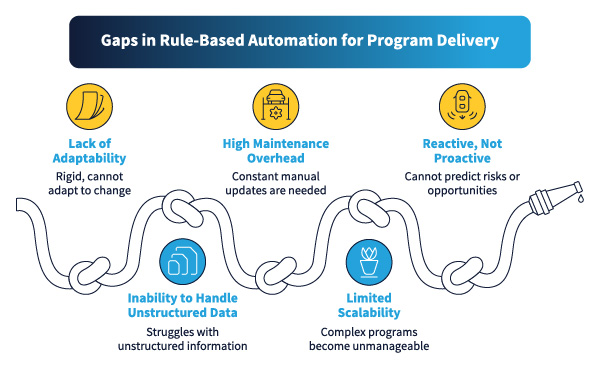
What’s emerging instead is an AgentOps model, an operating framework built to orchestrate humans, AI agents, and governance systems in one adaptive environment.
In an AgentOps setup, roles shift fundamentally:
Way Forward: How Service Organizations Can Get There and Lead in the AI-First Era
To embrace this future, IT services firms must evolve across multiple dimensions:
- Evolve Delivery Models
Move from traditional staffing to pod-based teams that can create and deploy AI agents as first-class team members. - Invest in Culture and Mindset
This isn’t just about money; it’s about risk appetite, experimentation, and resilience. Success will come to those who fail fast, learn, and iterate. - Upskill for the Agentic Era
Train teams to become AI designers and AI orchestrators, guiding agents, not just performing tasks. - Reimagine Commercial Models
Shift from effort-based billing to value-based outcomes. AI accelerators become the core IP and competitive moat for service providers. - Govern for Transparency
Make decisions, data, and AI logic visible by default to strengthen trust and accountability.
Success will come to those who fail fast, learn, and iterate in the Agentic Era.
These principles should be universal. Agent Ops and program delivery OS will fundamentally change how programs are delivered. The firms that master the orchestration of human and artificial intelligence will define the future of IT services.
Also Read: The Future of Project Manager: Mastering Intelligence in an AI-Driven World.

Sachin Kamath
 Outcreate Your Business
Outcreate with LTM
Outcreate Together

It’s time to Outcreate