A cyber attack that stole no data
On the night of October 11, 2026, attackers logged in to the refrigeration controllers of hundreds of French supermarkets and activated a defrost cycle that did not stop. Temperatures climbed to around 50°C and remained there for roughly six hours¹. France's finance minister later told Parliament that about 700 of the country's 10,000 supermarkets had been affected². The owner of the supermarket chain in France put the cost at tens of millions of euros, and insurers have since warned that most cyber policies exclude this type of physical loss³.
Three weeks later, a similar incident occurred in Belgium, Luxembourg, Sweden, and several other countries⁴. On November 9, French prosecutors linked the October attack to a cyber unit tied to Iran's Revolutionary Guard.¹
Nothing was encrypted, and no records were taken. Instead, the attackers used a routine maintenance function on equipment that contractors had left accessible from the internet. These devices were not necessarily on the radar of security teams or included in their own asset inventories. That visibility gap is the real issue. Refrigeration is simply where the problem surfaced first. Pharmacies, cold stores, factories, and data centers use similar controllers and often manage them in much the same way⁵.
Why the usual playbook missed it
Official guidance followed quickly. An alert issued by Computer Emergency Response Team – France (CERT-FR's) identifies Danfoss AK-SM and AK-SC controllers, along with Copeland and Dixell XWEB supervisors. It advises operators to disconnect these devices from the internet, update their firmware, and change default passwords⁶. The alert also includes a blunt warning: factory-resetting an end-of-life unit will not help because it will probably be compromised again.
On November 5, the US Cybersecurity and Infrastructure Security Agency (CISA), the Federal Bureau of Investigation (FBI), and three other US agencies issued a joint fact sheet recommending the same steps. The guidance also calls for sensible setpoint limits and alerts when those limits are breached⁵. That same week, three French blood banks reported temperature spikes after one of their refrigeration providers was targeted⁷.
These warnings did not come out of nowhere. Danfoss has said that its obsolete controllers were used against supermarkets in Russia and Israel in 2022.⁸ CISA published an advisory on the Danfoss AK-SM 8xxA in May 2025⁹ and another covering 23 flaws in Copeland's XWEB Pro in February 2026¹⁰. After the October incident, Danfoss said that most of the affected units no longer received security updates².
So why did so many security programs miss the risk? Most still rely on a vulnerability queue: scan, match CVEs, patch by severity, and prioritize anything in CISA's Known Exploited Vulnerabilities (KEV) catalog.¹¹ That approach offered little guidance in this case. The worst-hit units had no available patch. The Danfoss login flaw, which derives a valid password from the device's date, was rated as high complexity.⁹ And, at the time of writing, it is still not listed in KEV.
Building a resilient OT cybersecurity framework
Another tool will not close this gap on its own. What is needed is an approach that covers architecture, technology, people, and processes. It starts with deciding who owns the risk. In our view, the CISO should set the standard, facilities teams should manage it day to day, and contractors should be held accountable in writing. International Society of Automation and International Electrotechnical Commission (ISA/IEC) 62443 helps by giving all three groups a common language for zones and conduits.
The measures we would prioritize put firstare:
- Secure remote access: No controller should be directly reachable from the internet. Remote sessions should pass through a gateway with multifactor authentication (MFA), least-privilege access, and session logging.
- Establish secure OT zones: Keep control networks separate from enterprise IT and allow traffic between operational assets only through approved paths. A hijacked refrigeration controller should not become an entry point into store or head-office systems.
- Maintain OT asset visibility: Track every controller, its firmware, connections, known vulnerabilities, and business criticality. Include equipment installed by contractors, as this is often where visibility gaps arise.
- Implement OT-specific threat detection: Monitor process behavior, not just network traffic. A setpoint change at one store may be a technician's work. The same change across 50 stores within an hour is far more likely to indicate malicious activity.
- Strengthen vendor access governance: Third-party access should be approved in advance, time-limited, authenticated, monitored, and reviewed. These requirements should be included in maintenance contracts.
- Address legacy OT risks: Budget for replacing unsupported controllers and isolate them until replacement is possible. For the end-of-life units affected in France, isolation was the only control left.
- Prepare for operational disruption: OT incident plans need to include local intervention steps, manual operation, and continuity arrangements. At one Stockholm store, the attack began at 2 a.m., but nobody noticed for hours¹².
The aim is resilience as much as prevention. When an attack does gets through, the business still needs has to run safely.
Exposure and inventory deserve to come firstpriority, and Figure 1 shows why. Public warnings about this equipment were had been issued out months ago, and in one case years, before the attacks.¹³,¹⁴ . A CVE-driven program would never not have flagged the end-of-life units because , since there was nothing to patch. An inventory would have identified them from the outset.
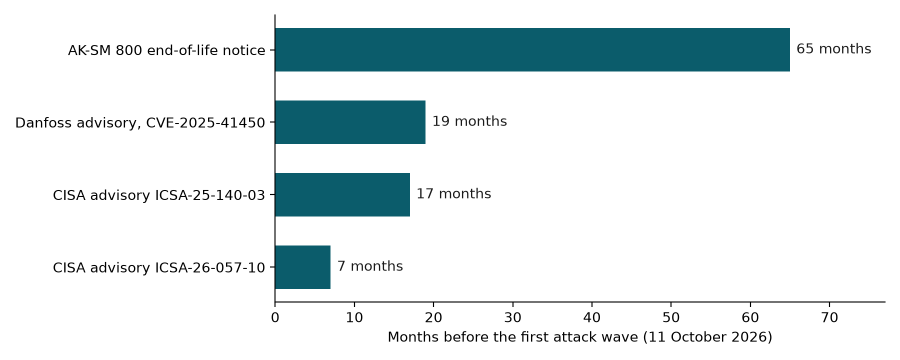
Figure 1: Months of public warning before the attacks
Boards will want to see progress. We suggest tracking three numbers: the share of OT assets inventoried, the number of controllers reachable from the internet (with a target of zero), and the share of vendor sessions routed through a brokered, recorded gateway. Figure 2 maps these measures against a 90-day plan.
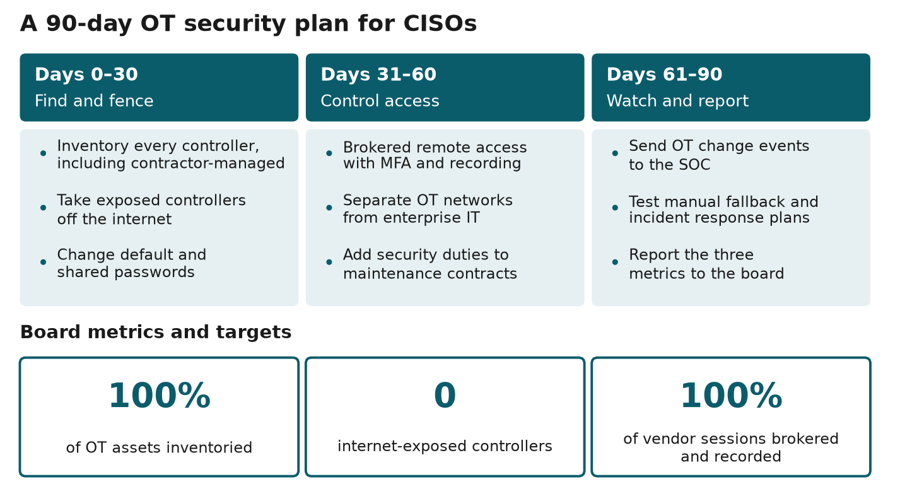
Figure 2: A 90-day plan and three board metrics
This approach will not suit every organization. A small retailer without a security operations center cannot run fleet-wide detection. Its priority should be reducing exposure and adding independent alarms through the contractor. Where older hardware cannot be modified, segmentation must provide protection until the equipment is replaced.
What gets in the way, and one team that moved fast
Why has this issue not been addressed already? Partly because ownership is unclear. Refrigeration sits somewhere between facilities, store operations, IT, and an outside contractor, while the CISO's remit usually stops at the IT boundary.
Budget is the other obstacle. Replacing hundreds of controllers competes with every other capital request, even though disconnecting one from the internet costs far less than losing a night's stock. Many maintenance contracts also predate any consideration of cybersecurity. And because no data is lost, the risk seldom reaches the board until the freezers fail.
Following the French attack, most of Belgian refrigeration installer Sabcobel's customers moved their remote management systems to secured connections, the company's chief executive told news agency Belga.⁴ When the second wave of attacks reached Belgium around midnight on November 1, Sabcobel's technicians worked through the night and into the morning to disconnect the units that were still affected. However, the company says a lasting solution will require both a software update and physical modifications to the equipment. The response highlights the need to address immediate exposure while also planning for the longer-term engineering changes required to secure the equipment.
Conclusion
Expect more incidents of this kind. Exposed controllers are easy to find, and US agencies say the activity is ongoing, and France has now named a state-linked actor¹,⁵. Within a year, regulators, auditors, and insurers will likely ask for evidence that contractor-managed OT has been found and secured. In the EU, NIS2 already counts food production, processing, and distribution among its critical sectors¹⁵. Boards will likely ask for that evidence first.
For CISOs, the takeaways are straightforward. Treat every connected controller as part of your risk landscape, regardless of who installed it. Use KEV listings and severity scores as a starting point, not the whole answer. Aim to bring the number of internet-exposed controllers to zero within 30 days and report on the three-board metrics within 90 days. Organizations that establish clear ownership now will have a concrete answer when the board asks.
Explore LTM's Cybersecurity Offerings
References
1. "France blames Iran for a cyberattack on supermarket fridges, Associated Press," 9 November 9, 2026: . https://apnews.com/article/france-cyberattack-supermarket-refrigerators-iran-6914ecf1a3285291653e103655f9e4a4
2. "Cyberattack hits 700 supermarkets in France, sparking investigation, Associated Press," 13 October 13, 2026:. https://apnews.com/article/france-cyberattack-supermarkets-refrigeration-systems-78a813a8efd466b360655339f96083dc
3. "French supermarkets' cyber insurance unlikely to cover food losses, insurers say," Reuters, 15 October 15, 2026:. https://www.reuters.com/legal/litigation/french-supermarkets-cyber-insurance-unlikely-cover-food-losses-insurers-say-2026-10-15/
4. "Second wave of refrigeration cyberattacks hits European supermarkets, Help Net Security," 2 November 2, 2026:. https://www.helpnetsecurity.com/2026/11/02/european-supermarkets-refrigeration-units-cyberattacks/
5. CISA, FBI, HHS, USDA and DOT, "US Government Partners Urge Hardening Industrial Refrigeration and Cold Chain Monitoring Systems," fact sheet, 5 November, 2026:. https://www.cisa.gov/resources-tools/resources/us-government-partners-urge-hardening-industrial-refrigeration-and-cold-chain-monitoring-systems
6. Incident de sécurité ciblant les contrôleurs à distance des installations de réfrigération, CERTFR-2026-ALE-012, October 12–16, 2026:. https://www.cert.ssi.gouv.fr/alerte/CERTFR-2026-ALE-012/
7. US agencies warn attackers are targeting refrigeration systems that protect food and medicine, Help Net Security, November 6, 2026: . https://www.helpnetsecurity.com/2026/11/06/cyberattacks-refrigeration-systems-cisa-fbi/
8. Pentagon treating military base freezer malfunctions as suspected cyberattack, Reuters, Military Times, October 29, 2026:. https://www.militarytimes.com/pentagon/2026/10/29/pentagon-treating-military-base-freezer-malfunctions-as-suspected-cyberattack-officials-say/
9. Danfoss AK-SM 8xxA Series (Update A)," ICS Advisory ICSA-25-140-03, May 2025, revised, CISA, August 26, 2025:. https://www.cisa.gov/news-events/ics-advisories/icsa-25-140-03
10. Copeland XWEB and XWEB Pro," ICS Advisory ICSA-26-057-10, CISA, February 26, 2026: https://www.cisa.gov/news-events/ics-advisories/icsa-26-057-10
11. Known Exploited Vulnerabilities Catalog, CISA,: https://www.cisa.gov/known-exploited-vulnerabilities-catalog
12. New cyberattack on supermarket fridges sweeps across Europe, CNBC (Reuters), November 2, 2026. https://www.cnbc.com/2026/11/02/cyberattack-on-fridges-hits-supermarkets-across-europe.html
13. IoT Tech News, "Hackers force European supermarket fridges into defrost," November 2, 2026: https://iottechnews.com/news/hackers-force-european-supermarket-fridges-into-defrost/
14. Danfoss, "Danfoss security advisories" (including DSA-2025-03-01, March 24, 2025): https://www.danfoss.com/en/service-and-support/coordinated-vulnerability-disclosure/danfoss-security-advisories/
15. European Union, Directive (EU) 2022/2555 (NIS2 Directive), Annex II: https://eur-lex.europa.eu/eli/dir/2022/2555/oj
 Outcreate Your Business
Outcreate with LTM
Outcreate Together

It’s time to Outcreate