Generative AI-based Solution for “Strengthening the Three Lines of Defense (3LOD) in Banking”

Introduction
The financial industry drives the global economy, but its exposure to risks has led to major disruptions. Some of the most severe economic crises in history stemmed from gaps in risk management and oversight. To address these vulnerabilities and enhance risk management in banking, the banking sector adopted the Three Lines of Defense (3LOD) model. This structured framework is designed to identify, assess, and mitigate risks while ensuring transparency and accountability. But why was this model introduced, and how does it help banks navigate modern challenges? Keep reading on to know.
The need for stronger risk management in banking
Banks face constant pressure from financial crises, regulatory scrutiny, and reputational risks due to inadequate risk management. The 2008 financial crisis highlighted significant gaps in risk oversight, prompting the banking industry to seek a more structured approach.
- Lessons from the 2008 financial crisis The 2008 financial crisis exposed significant weaknesses in risk management practices across the banking sector, showing how fragmented oversight could lead to systemic failures. The Three Lines of Defense model was formalized to address these shortcomings by clearly delineating responsibilities and ensuring proactive risk management.
- Rising regulatory expectations In the aftermath of the financial crisis, regulatory bodies worldwide introduced stringent regulations to safeguard the financial system. The 3LOD model helps banks stay ahead of regulations like Basel III and Dodd-Frank by clearly defining roles across risk management, compliance, and audit teams.
- Complex banking operations With globalization and digital transformation, banking operations have grown more complex. Managing risks effectively now requires real-time oversight, stronger collaboration, and the ability to adapt quickly to evolving threats.
What is the 3LOD model?
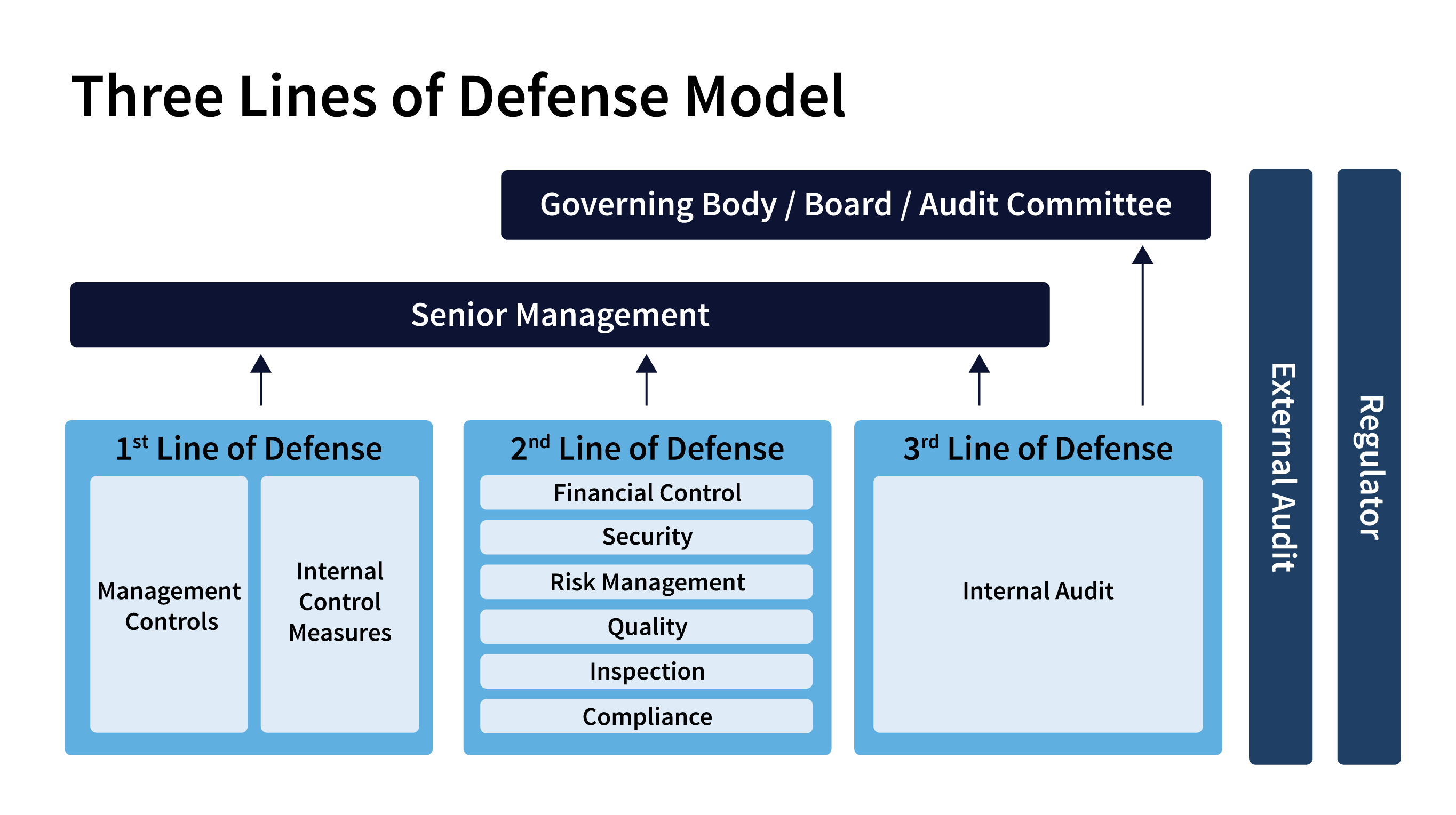
Figure-1: 3LOD
Source: The "four lines of defense model" for financial institutions - Occasional Paper No 11 The model was introduced to address several critical issues:
- Clear accountability: Before the model’s introduction, risk responsibilities were often fragmented, leading to gaps in oversight. The framework assigns specific roles to each line, ensuring clarity and accountability.
- Enhanced oversight: With three distinct layers of defense, organizations can ensure that risks are thoroughly identified, assessed, and mitigated, reducing the likelihood of oversight failures.
- Regulatory compliance: In response to stricter regulations like Basel III and Dodd-Frank, the framework helps banks demonstrate a robust and proactive approach to risk management in banking.
- Resilience against crises: By embedding risk management into daily operations, oversight, and independent assurance, the model builds organizational resilience against potential crises.
- Improved governance: The model facilitates better communication and collaboration between operational management, risk oversight, and internal audit, leading to improved governance and decision-making.
Challenges in implementing the Three Lines of Defence
Even with a well-defined structure, banks face obstacles in making the model work seamlessly. Some of the key challenges include:
- Defining entity relationships: Defining clear relationships between various entities can be challenging, which may dilute accountability and create inefficiencies
- Keeping up with regulatory changes: The regulatory landscape is constantly evolving, which requires continuous updates to the framework
- Data silos: Risk-related data is often scattered in silos, plagued by inconsistent formats and data governance issues
- Real-time monitoring: Effective risk management requires real-time data monitoring, which is often resource-intensive
- Compliance with data privacy regulations: Implementing technological solutions must align with data privacy laws such as GDPR or local banking regulations
- Integration of advanced tools: Adopting novel technologies such as AI and ML requires significant expertise and investment
How can banks overcome these challenges and strengthen risk management? This is where Generative AI comes in.
How generative AI enhances the 3LOD
Generative AI is reshaping banking operations, and its impact on risk management is profound. By automating processes, enhancing analytics, and providing real-time insights, AI strengthens each layer of the 3LOD model.
First line of defense: Operational management
Automating routine tasks: Gen AI can handle repetitive tasks such as data entry, transaction monitoring, and customer service, allowing employees to focus on more strategic activities. Improving decision-making: AI algorithms can analyze vast amounts of data to provide insights and recommendations, helping managers make informed decisions quickly. Enhancing customer experience: Gen AI-powered chatbots and virtual assistants can improve customer interactions by providing instant responses and personalized services.
Second line of defense: Risk management and compliance
The Generative AI “Risk Management 3LOD Framework” brings advanced capabilities to risk oversight: Advanced risk modeling: AI can identify entity relationships and enhance data connectivity, leading to more accurate risk assessments. Automated compliance monitoring: AI can monitor regulatory changes and ensure that the bank's operations comply with the latest regulations. This aids in improving the accuracy of risk assessments thereby reducing the risk of non-compliance. Fraud detection: AI can detect unusual patterns and anomalies in transactions, helping prevent fraud before it happens.
Third line of defense: Internal audit
The Generative AI “Risk Management 3LOD Framework (SoP Violation Identifier)” streamlines audit processes by: Automating audits: AI can automate routine audit processes, such as data collection and analysis, making audits more efficient and thorough. Enabling continuous monitoring: AI can help ensure continuous monitoring of transactions and operations, allowing auditors to identify issues in real-time and take corrective actions promptly. Enhancing audit reporting: Through AI-generated reports, it can provide valuable insights into the bank's risk management and control processes. A Gen AI-based specialized solution has the potential to alter the three lines of defense models for banks, leading to improved operations, regulatory compliance and risk management. Gen AI models can not only automate routine and mundane tasks, saving time and resources to focus on strategic activities, they can also enhance regulatory compliance by detecting unusual patterns and anomalies beforehand. A Gen AI-based solution can also help with internal audits by automating and continually monitoring the audit process. Therefore, what does the future hold for AI-driven risk frameworks?
Conclusion: The road ahead for AI in risk management
As Generative AI continues to evolve, its role in the Three Lines of Defense will expand, offering more sophisticated and dynamic solutions for risk management. From real-time analytics to automated policy generation, AI has the potential to transform how banks manage risks, ensuring greater stability and resilience in the face of uncertainty. A structured AI-driven framework, such as the PARCM Framework Enabler, can enhance the Three Lines of Defense by improving operational efficiency, strengthening regulatory compliance, and making risk oversight more proactive. However, successful adoption requires overcoming integration challenges while maintaining ethical and regulatory compliance. As financial institutions explore AI’s potential in risk management, industry leaders, including LTM, are actively shaping AI-driven audit and compliance solutions that help banks safeguard their bottom line and reputation. For more information, please reach out to: EAIBusiness.Advisory@LTM.com
More Articles For You
 Outcreate Your Business
Outcreate with LTM
Outcreate Together

It’s time to Outcreate