
Ask an AI agent to build a production performance data product today, and the code may arrive before your coffee cools. We are seeing SQL queries, automated transformations, dbt tests, and initial dashboard layouts generated in seconds. AI in data engineering is advancing faster than most of us anticipated, accelerating tasks that once took considerable time.
Yet working code is not necessarily a useful data product. In the energy sector, a data product earns the trust of the asset team only when it reflects how the business actually operates: how production statistics are measured, which operational rules apply, and where compliance boundaries lie. As code generation becomes easier, capturing and managing business context is emerging as a harder challenge for data professionals, both technical and functional.
The Three Languages of an Energy Operation
Walk into any upstream or midstream operation, and you will quickly notice that different teams speak different languages.
- A production engineer talks about wellhead pressures, decline rates, operating expenses, and daily volumes
- A flow-assurance specialist focuses on chemical dosage rates, paraffin buildup, corrosion tracking, and multiphase flow conditions
- A data engineer thinks in terms of schemas, DAGs, partitioning strategies, and latency layer
Each perspective is entirely valid, but none is sufficient on its own. A resilient data product must bridge all three. Historically, this translation has depended on knowledge held by individuals, scattered across operating procedures, spreadsheet definitions, and institutional memory from past projects.
Organizations may possess the knowledge, but AI cannot use it effectively without the right context. This is where domain knowledge in AI becomes essential: business expertise must be captured in a form that AI systems can access and apply.
Why This Gap Matters Right Now
The is already feeling the effects of this disconnect. In my experience, getting clean, reliable data has been a challenge since the earliest days of enterprise computing. Business knowledge rarely sits with one person. It is distributed across teams, creating a persistent gap between how the business operates and what technical teams build.
AI exposes that gap almost immediately. It can turn assumptions into SQL queries and dashboards in seconds rather than weeks, leaving little time for people to identify misunderstandings before they become part of the output. This is one reason Gartner predicted that, through 2026, organizations would abandon a significant majority of AI projects because of a lack of AI-ready data.
While that warning focuses heavily on raw data quality, the challenge goes deeper. An enterprise data warehouse can be well maintained, and Snowflake tables can be meticulously modeled, but AI may still misinterpret the data if it has not been given the business meaning of terms such as an "active well" or an enterprise-specific "lifting cost" under a joint venture agreement.
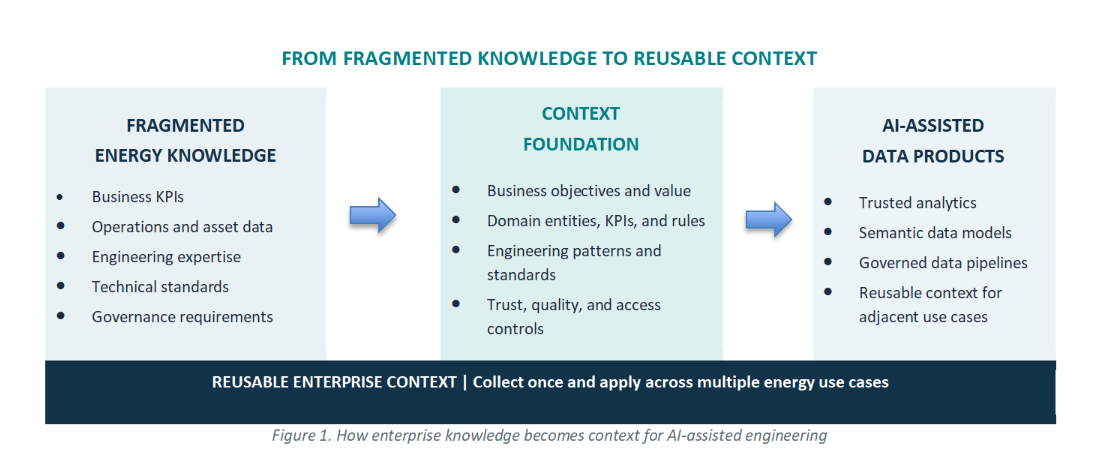
That is why context engineering is emerging as a critical discipline. Over the last decade, we have focused on making data machine-readable. The AI era now requires us to take the next step: making business logic understandable to machines. Domain knowledge in AI is not simply about giving models more data. It is about providing the operational definitions, relationships, and rules needed to interpret that data correctly.
To make context engineering practical, teams need to capture and structure four essential pillars before any code is generated:
- Business: Define the operational outcome the team is trying to achieve, the people and functions affected, and the metrics used to measure value.
- Domain: Document the entities, terminology, KPIs, and regulatory constraints specific to the problem.
- Data: Establish clear rules for integrating, modeling, transforming, and consuming data streams.
- Trust: Specify the security, data quality, and operational compliance standards the data product must meet.
The objective is straightforward: make expert domain knowledge available to AI at the point when engineering decisions are being made.
A Familiar Scenario in the Field
Imagine a vice president of production who wants to reduce the lifting cost per barrel of oil equivalent and asks the data team to deliver a performance data product by the end of the quarter.
The initial automated build is completed quickly. Pipelines run, tests pass, and the dashboard looks polished. But when a senior production engineer reviews it, the problems become apparent. Shut-in wells have been included in averages for active operational metrics, and gas volumes have been converted to barrels using an outdated volumetric ratio that finance has not approved.
Nobody made a careless mistake. The AI built what it was asked to build, but it lacked the local knowledge that everyone in the room took for granted.
Correcting these issues later can trigger a costly cycle of rework. What should have been established upfront becomes a retroactive discovery exercise. In some cases, teams may have to abandon the work and rebuild it from scratch.
Capturing Context Once and Reusing It
Many enterprises fall into trap of rebuilding context for every new initiative. Teams return to the same subject matter experts, revisit KPI definitions, and debate assumptions that may have already been settled in earlier projects.
In the energy sector, workflows such as decline curve analysis, production allocation, well-status monitoring, artificial-lift optimization, and reservoir forecasting rely on overlapping entities, terminology, and governance rules.
Enterprises already treat data models, code repositories, and infrastructure-as-code as reusable corporate assets. Domain context deserves the exact same treatment. When knowledge remains confined to ad-hoc conversations, every new project incurs another discovery effort. When it is structured and stored centrally, the context established for each data product can inform subsequent products and related use cases.
Where Human Judgment Belongs
None of this sidelines human expertise. It gives that expertise a more central role. Subject matter experts can shift their focus from writing boilerplate code to defining business meaning, validating KPIs, testing assumptions, and confirming that outputs reflect physical operating conditions.
AI can accelerate the work of writing pipelines and SQL queries. Human experts, meanwhile, establish and verify the business rules and governance boundaries that keep those outputs reliable. Ultimately, an enterprise AI strategy must ensure that human decision-makers remain responsible wherever business interpretation, operational risk, and financial accountability are involved.
Five Questions to Ask Before You Scale AI Coding
Shipping quickly means little if AI is working with incomplete or inaccurate context. Before measuring your data team by how quickly it delivers code and pipelines, consider whether it can provide reliable business context to the AI systems it uses.
The answers to these five questions can help assess your readiness:
- Are critical production and financial KPIs defined consistently across business units?
- Are core domain entities, relationships, and operational rules formally documented and accessible to AI?
- Can enterprise governance policies influence what an AI agent builds, rather than simply assess its output afterward?
- Can context captured for one analytics product be reused in adjacent or similar use cases?
- At which checkpoints is human sign-off mandatory to prevent operational hazards or inaccurate financial reporting?
Moving From Code Generation to Context Engineering
AI will continue to improve at writing code. These capabilities are likely to become widely available to competitors across the market. The greater competitive advantage will come from what an enterprise teaches its AI: its domain-specific business language, operating models, KPIs, safety rules, and the expertise its people have built over time.
That is the shift ahead. We are moving beyond prompting AI to write syntax and toward giving it the foundational context needed to reason about the data products it helps build. Teams that make this shift will be better positioned to deliver products that the business can trust and reuse context across subsequent projects.
The code may arrive before your coffee cools, but the understanding behind it is where enterprise investment truly belongs.
To see how we put these principles into practice for energy teams, explore DomainIQ on Snowflake.
Reference
- Lack of AI-Ready Data Puts AI Projects at Risk, Roxane Edjlali, Gartner, February 26, 2025: https://www.gartner.com/en/newsroom/press-releases/2025-02-26-lack-of-ai-ready-data-puts-ai-projects-at-risk
 Outcreate Your Business
Outcreate with LTM
Outcreate Together

It’s time to Outcreate