Accelerating Cloud Migrations with Clarity and Confidence

Leveraging the right cloud technology with appropriate strategies can lead to significant cost savings in the cloud migration process, enabling organizations to optimize their cloud spending and maximize the value of their investment. However, some businesses hesitate to pursue cost-saving measures in their multicloud strategy due to understandable concerns. Questions about application availability, data security, compliance, operations, and even data loss are key factors that influence the decision-making process. Ultimately, it comes down to one key question: Are the potential savings worth the risks involved?
Typical cloud migration barriers
Let’s face it, migrating applications to or across cloud providers is no small feat in the cloud migration process. It’s a complex endeavor that requires clarity and careful planning. For many organizations, this shift can bring a host of worries. Will applications remain stable throughout the transition? Could critical data be at risk? These are valid concerns and addressing them is key to successful migration. Let's take a closer look at some of the challenges we face in the market and how to mitigate them effectively.- Compatibility: Applications may rely on provider-specific services, APIs, or configurations, requiring significant re-engineering to ensure compatibility with the new cloud environment.
- Downtime, data integrity, and business continuity: Minimizing service disruptions, ensuring accurate data transfer without loss, and maintaining business operations during migration are critical challenges.
- Cost management: Migration can incur extra costs, including data transfer fees, re-engineering expenses, and potential increases in operational costs during the migration.
- Security, compliance, and licensing: Ensuring data security, regulatory compliance, and addressing licensing or legal issues during cloud migration are significant concerns.
- Performance and testing: Ensuring the application performs optimally in the new environment and conducting thorough testing to validate functionality can be time-intensive.
- Skill gaps and tooling: Teams may face a steep learning curve with the new provider’s tools and services, requiring updates to automation scripts, continuous integration (CI) and continuous delivery/deployment (CD) pipelines, and monitoring systems.
Simplify choices with a traffic light framework
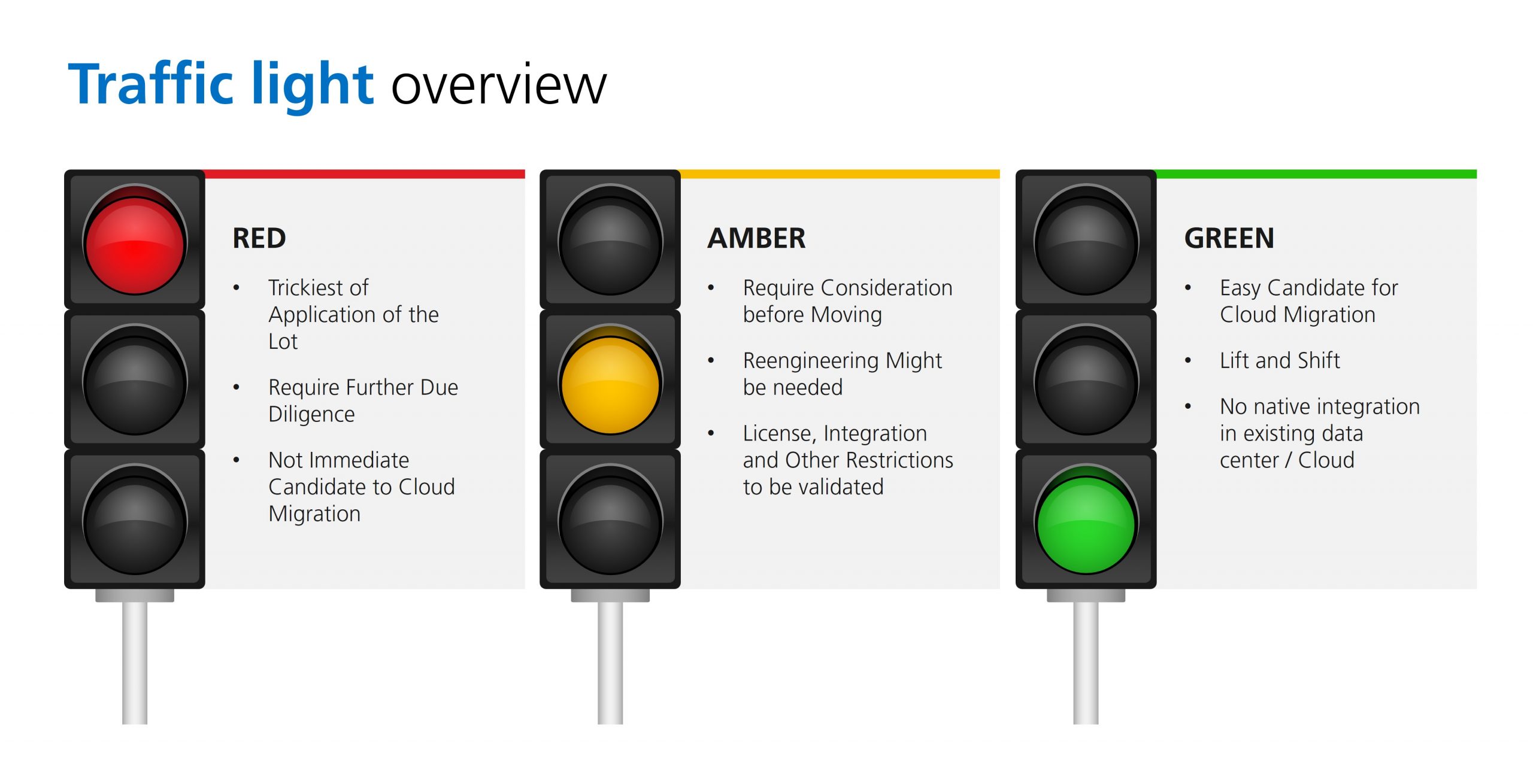
To address concerns and ensure a well-planned cloud migration process, we recommend starting with a cloud readiness and compatibility analysis. This involves conducting a comprehensive application risk assessment to provide clarity and confidence in your cloud migration strategy. A key component of this analysis is the traffic light framework, which categorizes applications into three distinct groups based on their readiness for migration.- Green: These applications are fully cloud-ready. They can be moved to the new environment with minimal effort or risk, making them the ideal starting point for your migration process. The "lift and shift" approach is commonly applied here.
- Amber: Applications in this group require more consideration and planning. They may need adjustments or discussions about alternative approaches to ensure a successful transition.
- Red: These applications are better off staying with their current cloud provider, either due to high complexity, critical dependencies, or because it is a unique cloud service from the current vendor.
Figure 1: Traffic light framework for assessing cloud-migration readiness
Discover how to unlock cloud cost savings with effective strategies and how the successful migration to Oracle cloud infrastructure (OCI) from another hyperscaler demonstrated potential cost savings of up to 50% through strategic planning and effective stakeholder engagement. In this case, 75% of the applications were moved by lift and shift expediting the cloud migration process with significant savings.Cloud shift with true insights
Enterprises can accelerate their migration drastically by leveraging automated tools and partnering with a proven and experienced cloud migration partner. Global system integrators are often instrumental in successful and swift cloud migrations helping enterprises expedite their cloud migration journey.Factors to consider in selecting a partner
Evaluate a cloud migration partner or global system integrator based on their experience and look for capabilities such as:- Streamlined data collection: Automated discovery minimizes the reliance on manual data gathering, cutting overall effort by as much as 50%.
- In-depth infrastructure assessment: A comprehensive and precise understanding of your existing infrastructure, enables faster and more informed decisions for migrating to the cloud.
- Intelligent cost analysis: Compare cost models and projections across multiple cloud platforms to make well-informed financial decisions tailored to your business needs.
- Comprehensive assessment reports: Select a partner who can provide detailed recommendations for infrastructure modernization, right-sizing, containerization, platform-as-a-service (PaaS) adoption, and leveraging managed cloud components to optimize your cloud strategy.
Eliminating risk and guesswork
Jumpstarting your cloud migration process with a cloud readiness assessment is a critical first step toward a successful, cost-effective, and secure transition. This cloud assessment acts as the foundation for your migration strategy, offering an in-depth understanding of your organization’s migration readiness and your current infrastructure’s compatibility with modern cloud ecosystems. By pinpointing areas that need attention, such as application dependencies and sizing recommendations, you can eliminate guesswork and move forward with clarity. A cloud readiness assessment doesn’t just inform your technical decisions; it also lays the groundwork for a solid business case for multicloud adoption. By exploring cost benefits, operational improvements, and risk mitigation strategies, the assessment equips you with relevant insights to make confident, informed choices across multiple cloud providers. This approach ensures your organization stays agile, scalable, and financially optimized. Take a look at how leveraging a cloud-readiness assessment helped a US-based marketing firm save 81% in costs compared to as-is sizing for migration. Whether it’s refining your migration strategy, identifying the best-fit applications to move, or right-sizing your infrastructure for maximum efficiency, a structured and thorough assessment gives you the tools to tackle cloud migration challenges head-on. Don’t leave your transition to chance—start with a cloud readiness assessment and step into the future of cloud computing with strategy and confidence. Learn more about how you get can on the fast-track to cloud migration by leveraging a cloud assessment and the benefits of a cloud assessment.Reference links:
1 Infinity Powering End-to-End Cloud Lifecycle Management 2 One stop multi-cloud platform for opmized Governance and FinOps 3 Oracle Database Migration Technologies 4 Oracle Migration HubMore Articles For You
 Outcreate Your Business
Outcreate with LTM
Outcreate Together

It’s time to Outcreate