Agentic AI
AI agents that act, decide, and execute decisions autonomously
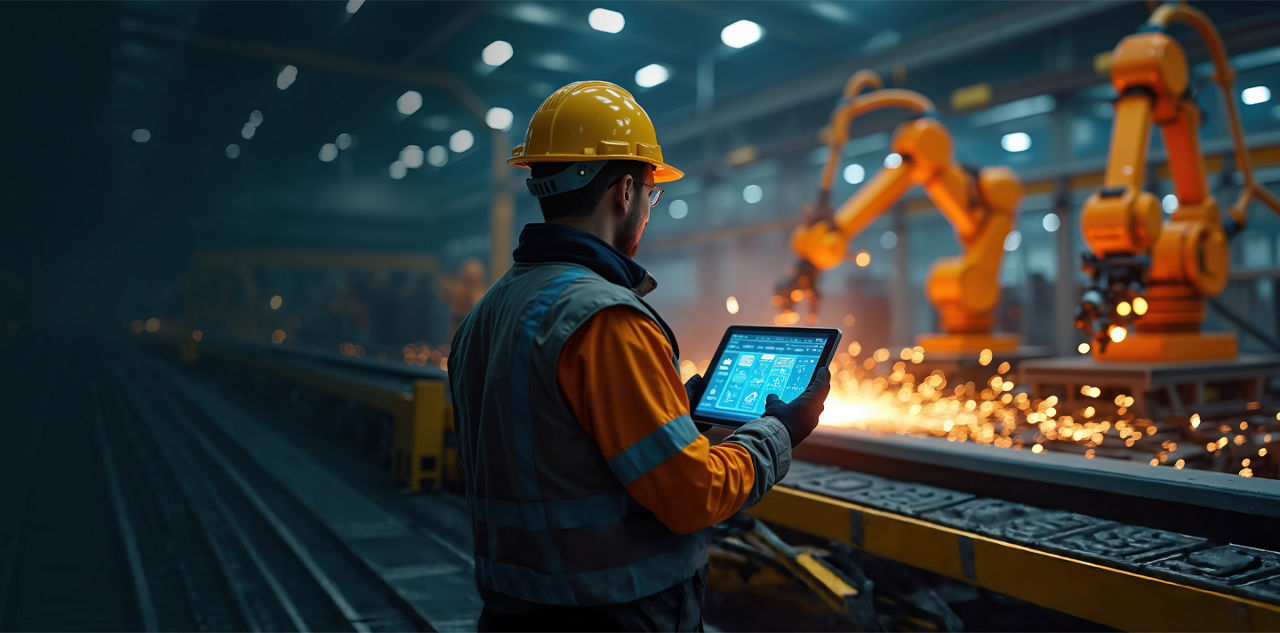
Industrial AI has taken center stage in the manufacturing industry, driven by the rapid evolution of Generative, Agentic, and Multimodal AI. These advancements are enhancing existing processes and redefining how manufacturers operate, compete, and create value.
Enterprises are no longer just experimenting, with substantial capital allocation and the implementation of operating models for day-to-day decision-making. AI adoption helps keep pace through smarter, faster, and more resilient operations.

Our clients want AI integrated into their platforms, workflows, engineering teams, and decision-making processes to surpass the competition through faster, smarter, and more resilient operations. We partner strategically with them, focusing on driving tangible business outcomes rather than delivering standalone proofs of concept. These include:
Today, leading manufacturers are adopting Business AI as a key part of their ongoing innovation strategy, aiming for a more integrated, enterprise-wide transformation. To realize AI's full potential and achieve meaningful ROI, organizations require a comprehensive, value-chain-driven approach that links data, decisions, and execution.
At LTM, our Business AI offering combines enterprise data, manufacturing expertise, business context, and agentic AI to support this transformation. We collaborate with clients to implement, scale, and embed AI into workflows, facilitating predictive insights, autonomous decisions, and measurable results, thereby creating a sustainable competitive edge. The impact spans the entire manufacturing landscape, powering a wide range of high-value business processes, including:
AI agents that act, decide, and execute decisions autonomously
Enterprise data integration across Enterprise Resource Planning (ERP), Customer Relationship Management (CRM), Manufacturing Execution System (MES), and Internet of Things (IoT)
Predict, prescribe, and automate
Continuous learning loops for scale and accuracy
LTM BlueVerse™ is an AI-native ecosystem designed to prepare organizations for the future—enabling them to confidently build, deploy, and scale intelligent, agent-driven solutions.












Meet our AI in manufacturing leaders with hands-on experience across aerospace, automotive, and process industries. They help you connect shop-floor insights with enterprise decisions and build operations that adapt to demand and disruption.
 Outcreate Your Business
Outcreate with LTM
Outcreate Together
Outcreate Your Business
Outcreate with LTM
Outcreate Together