
Industrial enterprises have invested heavily in automation, connected assets, and enterprise platforms. Yet operational decisions still rely on fragmented data, siloed workflows, and human interpretation, leaving much of the value within industrial data untapped.
Industrial AI is redefining what industrial intelligence looks like. It moves beyond automation and analytics to help enterprises Outcreate conventional operational decision-making. By combining multimodal intelligence, digital twins, agentic AI for industrial operations, and autonomous execution, Industrial AI enables systems to perceive, simulate, reason, decide, and act autonomously. The result is more intelligent operations, faster decisions, and continuous optimization across the industrial value chain, accelerating industrial digital transformation.
Built for Industry. Designed for Autonomous Operations.
Industrial knowledge, operationalized
Critical expertise often resides with engineers and operators. Industrial AI transforms that knowledge into AI-powered copilots, intelligent agents, and reusable decision intelligence, enabling faster problem-solving, more consistent decisions, and accelerated workforce enablement.
Predictable performance, by design
High-performing operations do more than automate. They continuously learn, adapt, and improve. By combining operational context, simulation, and AI-driven decision intelligence, Industrial AI helps improve productivity, asset utilization, and operational performance.
Decisions at the speed of operations
Disconnected systems slow execution and limit business performance. Industrial AI connects operational data, domain knowledge, and AI agents, to enable proactive planning, predictive maintenance, and real-time operational decisions that reduce downtime and improve throughput.
Autonomous, future ready operations
Move beyond automation with digital twins, intelligent agents, robotics, and autonomous execution. Powered by Agentic AI for industrial operations, Industrial AI enables enterprises to build operations that perceive, reason, decide, and continuously optimize across the industrial ecosystem.
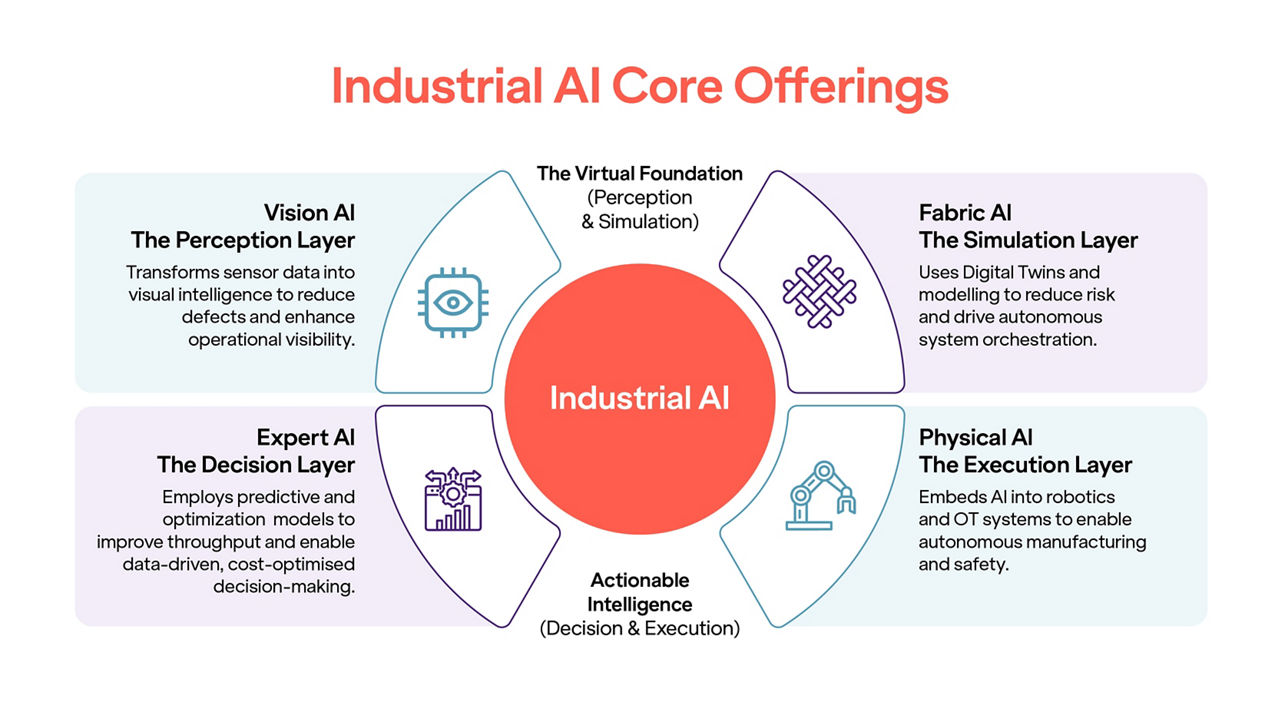
1. Vision AI
Transform industrial vision into operational intelligence through multimodal AI that combines visual, thermal, and acoustic intelligence for quality inspection, asset monitoring, safety, and operational awareness.
Key Capabilities
Intelligent Quality Inspection
AI-powered vision and multimodal analysis for defect detection, assembly validation, and packaging compliance.
Outcome: Near-zero defects, improved yield, and reduced scrap
Quality, Maintenance & Multimodal Intelligence
Combines vision, thermal, acoustic, and operational data to identify anomalies, hidden defects, and equipment issues early.
Outcome: Improved quality, enhanced safety, and earlier issue detection
Safety & Compliance Intelligence
Real-time monitoring with computer vision, activity recognition, and contextual AI reasoning.
Outcome: Safer workplaces and stronger regulatory compliance
Production Intelligence & Vision-Guided Automation
Vision-Language-Action frameworks integrated with robotics and MES to enable adaptive automation.
Outcome: Higher throughput and more flexible operations
Inventory & Supply Chain Visibility
AI-driven tracking, counting, and reconciliation across inventory flows and logistics environments.
Outcome: More than 99% inventory accuracy and reduced stockouts
Sustainability & Zero-Waste Operations
Multimodal monitoring and AI-driven optimization for energy, emissions, and waste reduction.
Outcome: Improved ESG performance and reduced operational waste
2. Fabric AI
Build intelligent digital environments using digital twins, simulation, industrial data platforms and small language models (SLMs) that improve planning, optimization, and operational visibility before execution.
Key Capabilities
Digital Twin Platform (Asset, Process, Enterprise)
Connected digital twins across assets, processes, and enterprise operations using real-time operational data.
Outcome: Greater visibility and improved asset utilization
Simulation & Scenario Intelligence
Physics-based and AI-driven simulations for what-if analysis, virtual commissioning, and decision validation.
Outcome: Reduced risk and faster decision-making
Context & Knowledge Intelligence (Ontology Layer)
Industry-aligned Small Language Models embedded within digital twins for contextual reasoning and natural-language interaction.
Outcome: Better decision support and operational understanding
SLM-Driven Twin Intelligence
Industry-aligned Small Language Models embedded within digital twins for contextual reasoning and natural-language interaction.
Outcome: Better decision support and operational understanding
Virtual Factory & Autonomous Orchestration
Closed-loop workflows combining digital twins, simulation, and agentic AI.
Outcome: Transition to autonomous, self-optimizing operations
3. Expert AI
Enable faster, data-driven decisions using AI-powered optimization across production planning, maintenance, inventory, scheduling, and supply chain operations.
Key Capabilities
Planning & Scheduling Optimization
AI-powered optimization and simulation-led planning for production and resource scheduling.
Outcome: Higher throughput and improved planning efficiency
Simulation-Driven Decision Intelligence
Decision agents combine simulation outputs and operational data to recommend optimal actions.
Outcome: Faster, risk-informed, and optimized decision-making
Process & Real-Time Optimization
Continuous optimization using operational data, predictive intelligence, and advanced control models.
Outcome: Improved yield and lower energy consumption
Supply Chain & Inventory Optimization
AI-powered forecasting, inventory optimization, and logistics planning.
Outcome: Reduced inventory costs and improved service levels
4. Physical AI
Bring intelligence into the physical world by connecting AI with robotics, industrial control systems, and autonomous execution across shop floor and operational environments, supporting industrial digital transformation.
Key Capabilities
Autonomous Production & Robotics
AI-powered robotics, cobots, AGVs, and AMRs with intelligent perception and control.
Outcome: Higher throughput and flexible manufacturing
Energy & Sustainability Execution
Real-time execution of energy optimization strategies through intelligent control systems.
Outcome: Lower energy consumption and reduced emissions
Intelligent Intralogistics & Material Flow
AI-driven coordination of warehouse operations, routing, and material movement. Executes optimized routing and scheduling decisions using real-time control of AGVs/AMRs, warehouse systems, and shopfloor logistics platforms
Outcome: Improved operational efficiency, reduced delays, and higher inventory accuracy



Contact Us
 Outcreate Your Business
Outcreate with LTM
Outcreate Together

It’s time to Outcreate