LTIMindtree Logo
logo_lnt_group_company
  • What we do
  • CAPABILITIES
    iRun
    • Application Management Services  
    • Cognitive Infrastructure Services
    • Cybersecurity
    iTransform
    • AI-led Engineering
    • Data and Analytics
    • Enterprise Applications
    • Interactive
    • Industry.NXT
    Business AI
    • BlueVerse
    PROPRIETARY OFFERINGS
    • GCC-as-a-Service
    • Unitrax
    • Voicing AI
  • Industries we serve
  • INDUSTRIES
    • Banking
    • Capital Markets
    • Communications, Media and Entertainment
    • Energy & Utilities
    • Healthcare
    • Hi-tech
    • Insurance
    • Life Sciences
    • Manufacturing
    • Retail and CPG
    • Travel, Transport and Hospitality
  • About us
  • ABOUT US
    • Company
    • Investors
    • Brand
    • Newsroom
    • Partners
    • Insights
    • Environment, Sustainability and Governance
    • Diversity, Equity and Inclusion
  • Careers
logo_lnt_group_company
Contact
  • What we do
    CAPABILITIES
    iRun
    • Application Management Services  
    • Cognitive Infrastructure Services
    • Cybersecurity
    iTransform
    • AI-led Engineering
    • Data and Analytics
    • Enterprise Applications
    • Interactive
    • Industry.NXT
    Business AI
    • BlueVerse
    PROPRIETARY OFFERINGS
    • GCC-as-a-Service
    • Unitrax
    • Voicing AI
  • Industries we serve
    INDUSTRIES
    • Banking
    • Capital Markets
    • Communications, Media and Entertainment
    • Energy & Utilities
    • Healthcare
    • Hi-tech
    • Insurance
    • Life Sciences
    • Manufacturing
    • Retail and CPG
    • Travel, Transport and Hospitality
  • About us
    ABOUT US
    • Company
    • Investors
    • Brand
    • Newsroom
    • Partners
    • Insights
    • Environment, Sustainability and Governance
    • Diversity, Equity and Inclusion
  • Careers
Contact
  1. LTIMindtree is now LTM | It’s time to Outcreate
  2. Insights
  3. Povs

Strategic Imperatives for Healthcare Payers: Building Capabilities to Power the Agentic AI Ecosystem

Shiba Brata Das
Shiba Brata Das
Chief Architect – Healthcare, LTM

The AI revolution has brought an unprecedented shift in everything we have done for years. This shift has unfolded in multiple waves, starting with the introduction of Pre-trained Language Models, followed by Large Language Models (resulting in widespread application of Generative AI). Multi-modal and Tool-augmented AI followed, with 2025 being the era of Agentic AI solutions. 

To this end, organizations across industries have been actively reimagining how to embed intelligence into their business processes and systems. Enterprise AI adoption has struggled due to one fundamental barrier: Injecting rich, contextual, and often sensitive organizational data into AI workflows while maintaining compliance, governance, and continuity.  

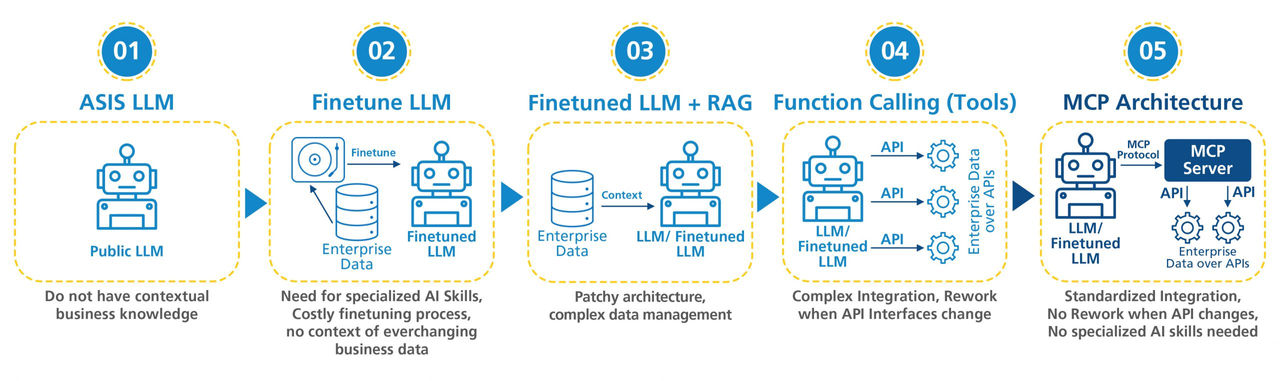
AI adoption at an enterprise level has been evolving over the following four distinct stages, the fifth of which is the topic of this blog.

As depicted above, we initiated approaches like fine-tuning Large Language Models (LLMs) with contextual static business data. We then patched the architecture by enabling Retrieval-Augmented Generation (RAG) and Function Calling, which attempted to bridge the gap by injecting contextual business information into LLMs. However, each approach still lacks a standardized manner to gain holistic awareness of the enterprise’s knowledge. Many AI initiatives remain siloed, manual, or exploratory because of the absence of a common, shared data access layer that is controlled, composable, and policy-aware.  

This is, however, beginning to change. Model Context Protocol (MCP) is an open standard developed by Anthropic to enable dynamic, context-rich, and standardized interactions between LLMs and organizational data. MCP introduces a structured, secure way to define, manage, and serve sensitive organizational data to agents and AI applications. It lets enterprises control what data is shared and how, when, and with whom. This brings governance and granularity to AI workflows, enabling real-time decision-making without surrendering oversight. This article provides an industry perspective on how MCP capabilities can be utilized in the payer-provider agentic ecosystem, benefiting both parties.

Building the MCP Server Capability: What It Entails

Today, there is a shift towards a broader architectural blueprint for enterprise-grade, context-aware AI solutions. Implementing MCP in these solutions inherently addresses significant challenges in the Agentic AI domain:

  • Interoperability

MCP establishes a vendor-neutral standard, ensuring seamless connectivity between models and tools, regardless of the platform or provider.

  • Scalability

MCP facilitates scalable integration through modular, clean protocols, eliminating the need for fragile, one-off function calls.

  • Real-time access

MCP enables models to dynamically discover and utilize tools, underlying data, and capabilities, enhancing the adaptability and responsiveness of AI workflows.

  • Unified Architecture

MCP’s standardized interfaces and shared context layer streamline integration while preserving contextual continuity, enabling AI systems to deliver more accurate, relevant insights with reduced technical complexity

  • Structured Governance

MCP enables secure, policy-driven access to enterprise data, ensuring adherence to regulatory requirements and internal governance, absoluerly crucial for enterprise-grade compliance and trust.

  • Composable Intelligence

With off-the-shelf modular capabilities, MCP supports rapid adaptation to diverse enterprise use cases, accelerating AI adoption across internal teams, customers, and partners

Establishing key capabilities within the MCP server is essential in the payer-provider ecosystem. This allows for the development of robust off-the-shelf capabilities ready to support a variety of use cases pertinent to both payers and providers. This helps organizations achieve greater efficiency, flexibility, and scalability while working with AI-based interactions and workflows. 

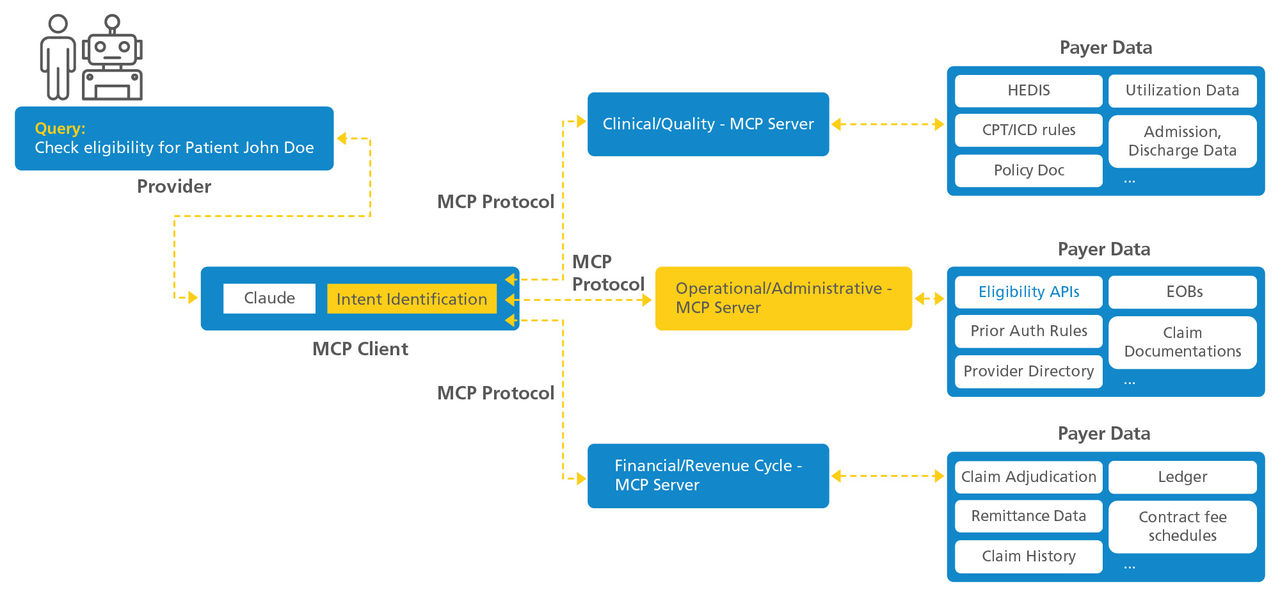
To this end, we have categorized the MCP server for a payer organization under three heads, with suggestive tools catering to a variety of use cases.
Architecture: Payer–Provider Agentic Workflow

~ai-d20097d3-c10a-4f4b-ba14-c880896b3250_

The above infographic illustrates the patient eligibility verification at the front office desk. The verification module is a user interface equipped with MCP Client capabilities for direct interaction with LLM. In healthcare, it can serve either as a clinician/provider-facing AI assistant or a patient-facing app for appointment scheduling, medication management or care guidance. 

Once the intent of the query is successfully identified (eligibility verification) the request is routed to the appropriate MCP server (in this case the Operational/ Administrative MCP server) that can answer the query. This protocol ensures consistent exchange of information regardless of the services or tools used. Although portrayed as tools, they are FHIR (Fast Healthcare Interoperability Resources)-based payer data interfaces or APIs (Eligibility APIs), which have emerged as proven and time-tested solutions. MCP’s standardized approach aligns perfectly with this consistent electronic data exchange pattern

Context with Compliance: Embedding Healthcare Guardrails into MCP

While MCP offers a platform to manage context in agentic AI systems, its general purpose and design need to be carefully evaluated and adjusted to address the specific requirements of healthcare. Payer organizations operate under stringent regulatory requirements such as HIPAA, HITECH, and CMS interoperability mandates. These frameworks define strict data access, consent, auditing, and traceability rules. While developing MCP-aligned solutions, it is imperative to have sufficient guardrails that enforce context isolation, role-based access, data minimization, and lifecycle controls. Without these layers, even well-intentioned AI systems risk accidental overreach.

Conclusion

Given the need for trustworthy, enterprise-grade, and production-ready solutions, MCP servers must be continuously strengthened, refined, and leveraged across the organization. They must evolve and become smarter, resilient, and accurate as they are stress-tested across diverse internal workflows and external integrations. Their long-term value compounds when stakeholders across departments can build AI agents from a shared, secure, and well-governed context layer. In this pattern, AI agents respond and analyze a user’s intent, select the right tools, and execute actions with confidence and traceability, elevating themselves from helpful AI assistants to trusted organizational collaborators.

References

  1. Introduction – Model Context Protocol| New Window
  2. Model Context Protocol: How It is Changing Healthcare Chatbots| New Window
  3. https://innovaccer.com/resources/blogs/introducing-hmcp-a-universal-open-standard-for-ai-in-healthcare| New Window
  4. GitHub – modelcontextprotocol/servers: Model Context Protocol Servers

It’s time to Outcreate

Outcreate Your Business

  • Industries
  • iRun
  • iTransform
  • Business AI

Outcreate with LTM

  • Brand
  • Company
  • Careers
  • Locations

Outcreate Together

  • Investors
  • Newsroom
  • Partners
LTIMindtree Logo

It’s time to Outcreate

  • Industries
  • iRun
  • iTransform
  • Business AI
  • Brand
  • Company
  • Careers
  • Locations
  • Investors
  • Newsroom
  • Partners
LTIMindtree Logo
Accessibility Modern Slavery Statement Privacy Statement Responsible Disclosure

Stay connected for latest updates on LTIMindtree