More than 78,000
monthly active users
LTM is a global technology consulting and digital solutions company with more than 90,000 employees across 40 countries. To modernize its human resources (HR) support experience, the company introduced the Microsoft Copilot Studio agent RAIma. Deployed to Microsoft Teams and Microsoft 365 Copilot, RAIma serves as a super agent and the central conversational entry point for all HR‑related tasks.
Integrated with SharePoint, ServiceNow, and core enterprise systems, RAIma delivers fast, consistent, and high‑quality support at scale. With more than 78,000 monthly active users, it has become a core part of how employees access HR services across the organization.
This case study highlights how LTM designed and built RAIma, including its multi‑agent design, integrations, knowledge sources, and telemetry‑driven optimization using Azure Application Insights.
Supporting a workforce of nearly 87,000 employees across 40 countries required HR assistance that was fast, reliable, and consistent. LTM’s existing virtual assistant had become difficult to update, and even small enhancements required significant engineering effort. This created delays, limited accuracy improvements, and led to a fragmented employee experience.
As HR services expanded and employee expectations increased, the limitations of the legacy solution became more visible. LTM needed a modern and flexible foundation that could simplify operations, reduce manual work, and support rapid iteration. The company also wanted a solution that could scale effortlessly across its global workforce while delivering dependable, high‑quality HR support in every interaction.
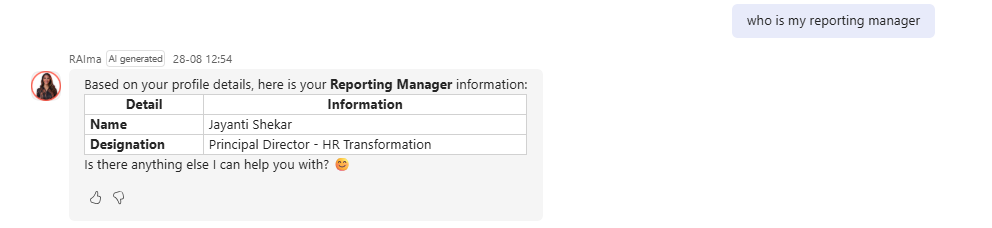
RAIma is a Copilot Studio agent that serves as a super agent that orchestrates the HR experience for LTM’s employees across the full hire to retire lifecycle. It answers candidate questions during the attract and acquire phase and provides pre‑boarding clarity. It then guides new hires through onboarding by scheduling induction activities and connecting them with the right people across the organization, such as buddies, mentors and HR partners.
RAIma supports employees at every stage of their journey such as helping them set goals, access learning, request feedback, and manage performance.
RAIma supports employees at every stage of their journey such as helping them set goals, access learning, request feedback, and manage performance. It also provides policy guidance, offers career insights to support retention and guides employees thorugh offboarding. Throughout the journey, it enables employees to complete HR tasks such as policy queries, leave management and ticket creation through a unified conversational experience in Microsoft Teams or Microsoft 365 Copilot
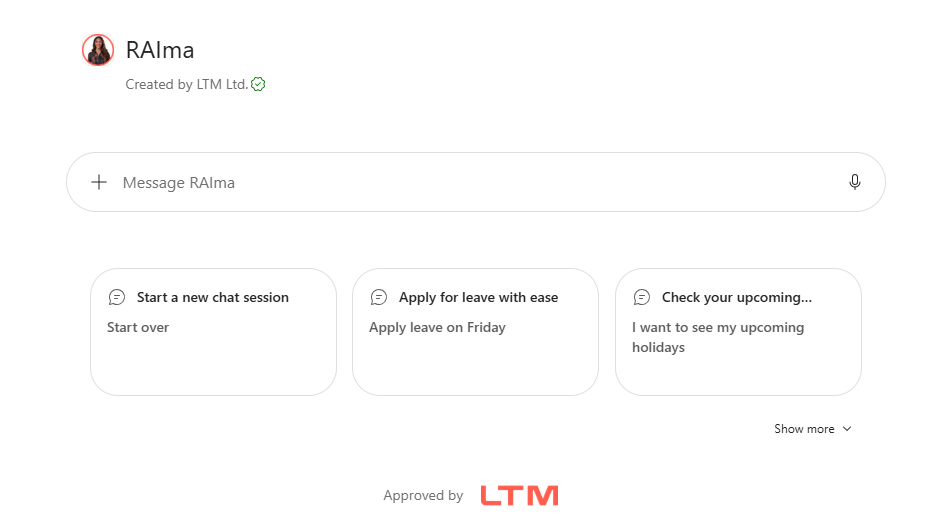
RAIma supports more than 78,000 monthly active users, improves response accuracy compared to the previous HR assistant, reduces engineering complexity and maintenance overhead, and establishes a foundation for future multi‑agent HR capabilities. Key benefits include:
monthly active users
employee queries resolved with approximately 75 percent positive feedback, reducing response times from days to seconds
overall HR self-service experience
prompts per month, ensuring instant access to HR information.
“Using RAIma in my day-to-day work has made things easy and stress-free. I don’t have to search across different systems for policies or answers; everything is available through a simple chat. I can also apply for leave, book my seat, and raise tickets through RAIma.”— T. Sivarama Sarma, Principal, Data Sciences, LTM.
LTM also successfully filed a patent with the Indian Patent Office for its approach: Method and system for providing coordinated contextaware compliant services across an employee lifecycle.
RAIma uses a multi‑agent architecture centered on a primary orchestrator agent that coordinates with specialized connected agents and external systems. The design enables modularity, scalability, and easier maintenance.
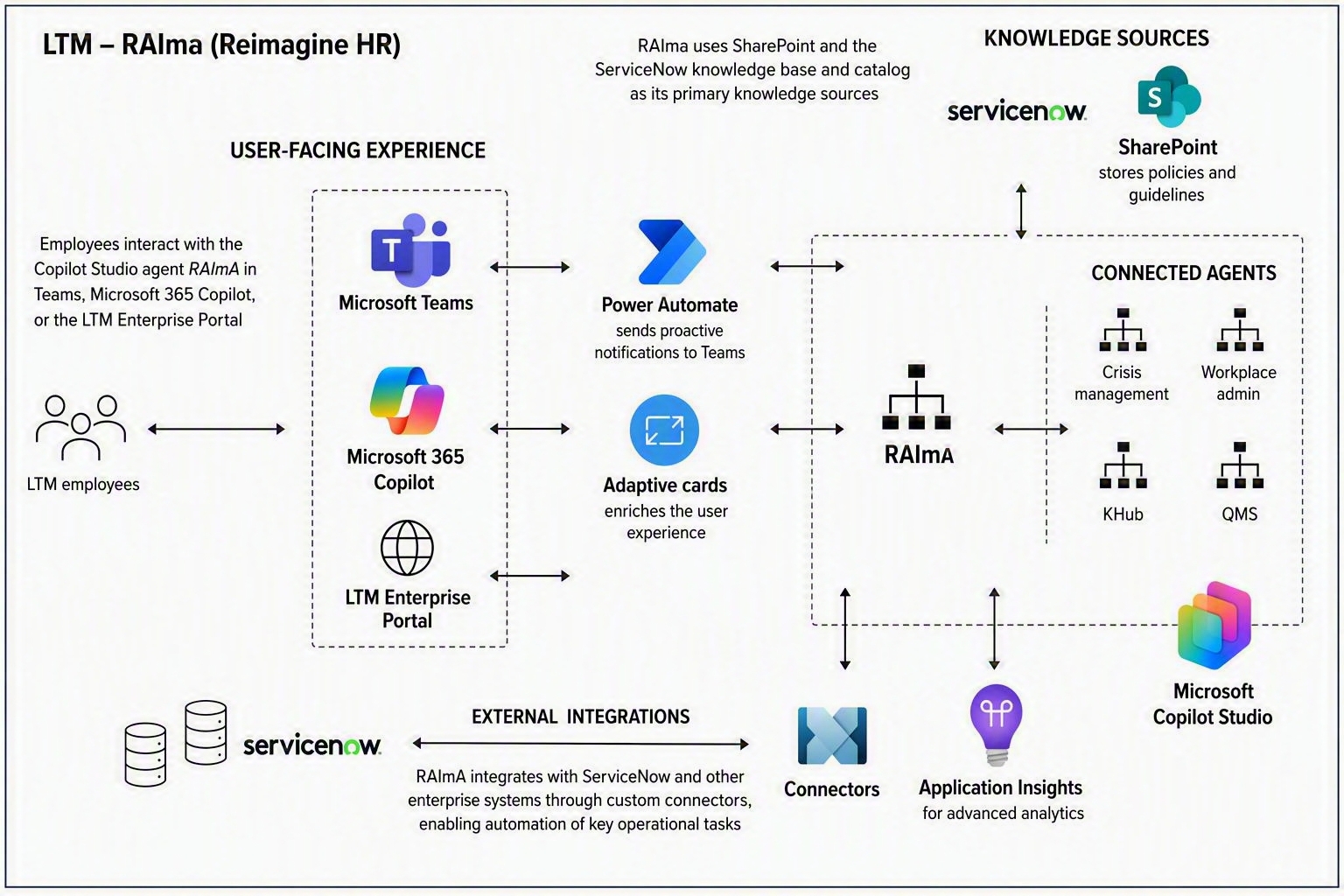
User-facing experience:
Knowledge sources:
External integrations:
Connected agents:
Notifications and advanced analytics:
RAIma streamlines HR interactions by enabling employees to complete key HR processes though a conversational interface, including:
1. Unified Employee Experience Hub
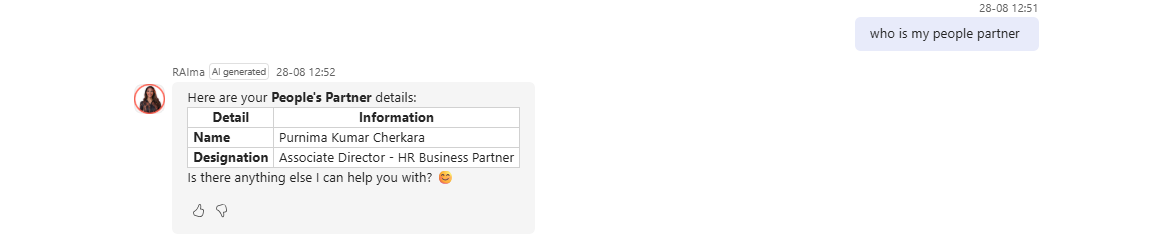
Provides a single conversational interface for employees to access HR, IT, workplace, learning, payroll, leave, benefits, and policy services.
Integrates multiple enterprise systems, reducing navigation effort and improving self-service adoption.
2. Employee Self-Service & Transaction Automation
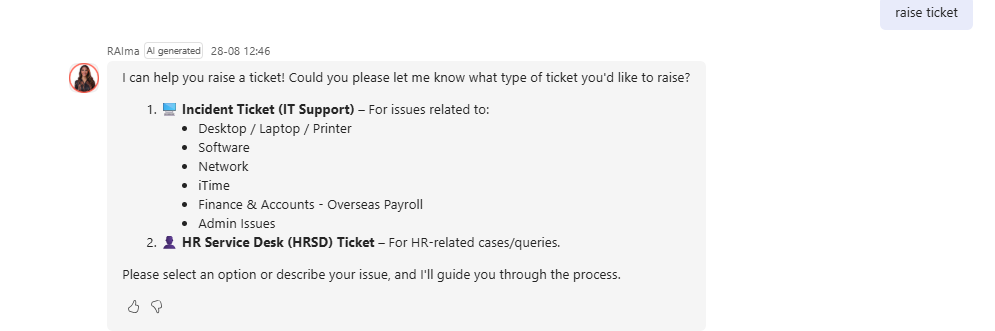
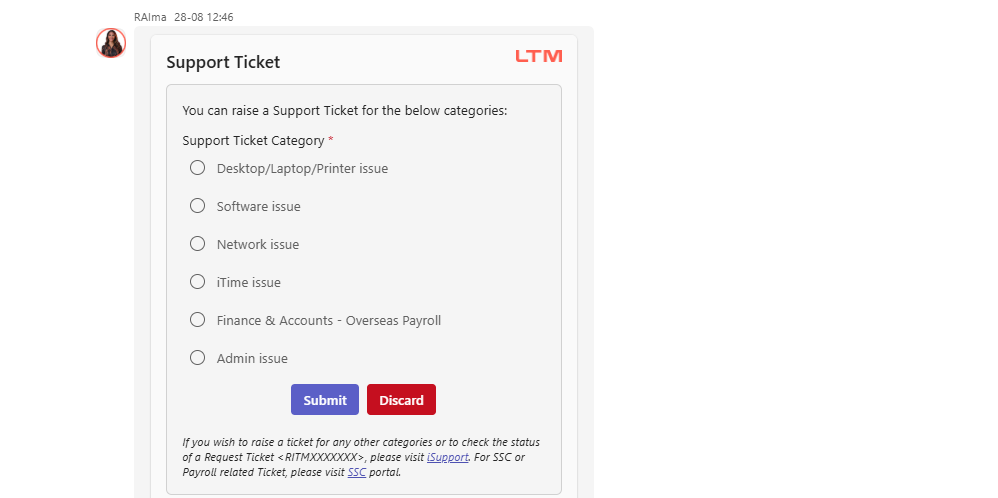
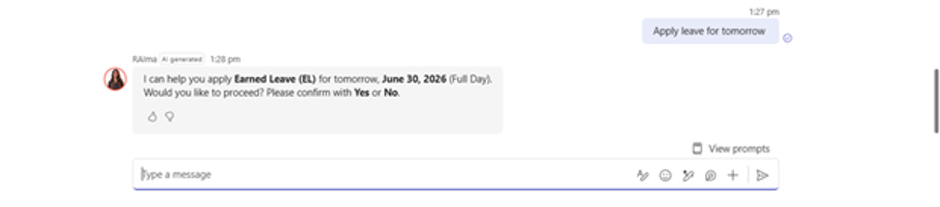
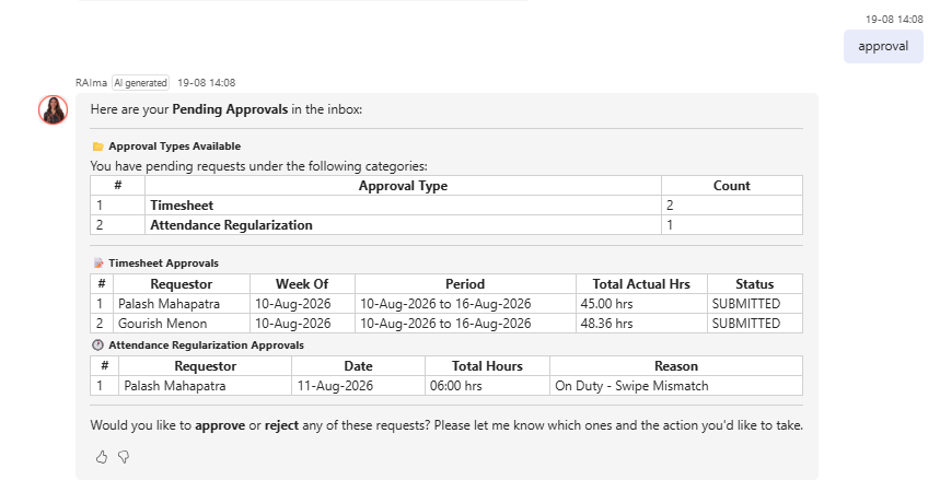
Enables employees to apply for leave, download payslips and letters, book workspaces, raise HR and IT requests, track incidents, manage attendance, access visa and immigration information, and complete routine transactions directly through RAIma.
Automates approvals, cancellations, modifications, and service request workflows.
3. AI-Powered Knowledge & Query Resolution
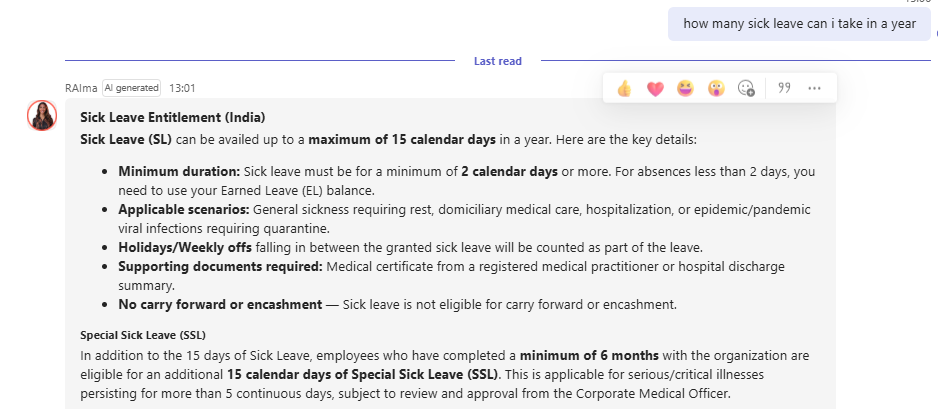
Answers employee questions across HR policies, benefits, leave, payroll, onboarding, separation, learning, performance, insurance, compliance, and workplace services.
Continuously learns from HR service desk interactions and employee documentation to improve response accuracy.
4. Personalized Employee Insights
5. Manager & Leader Enablement
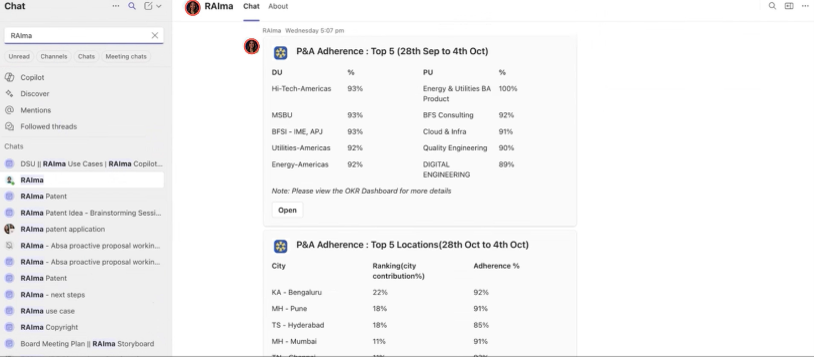
Delivers team-level insights on attendance, leave, persona adherence, goal-setting progress, workforce demographics, and organizational structure.
Supports managers with approval workflows and people-related decision support.
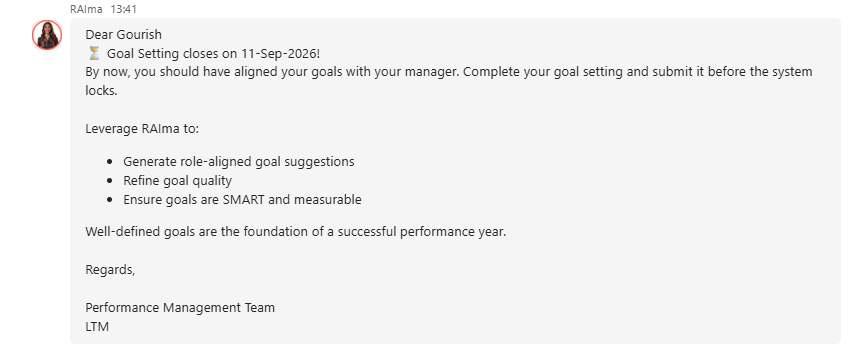
6. Predictive Nudges & Intelligent Reminders
7. Workforce Analytics & Leadership Dashboards
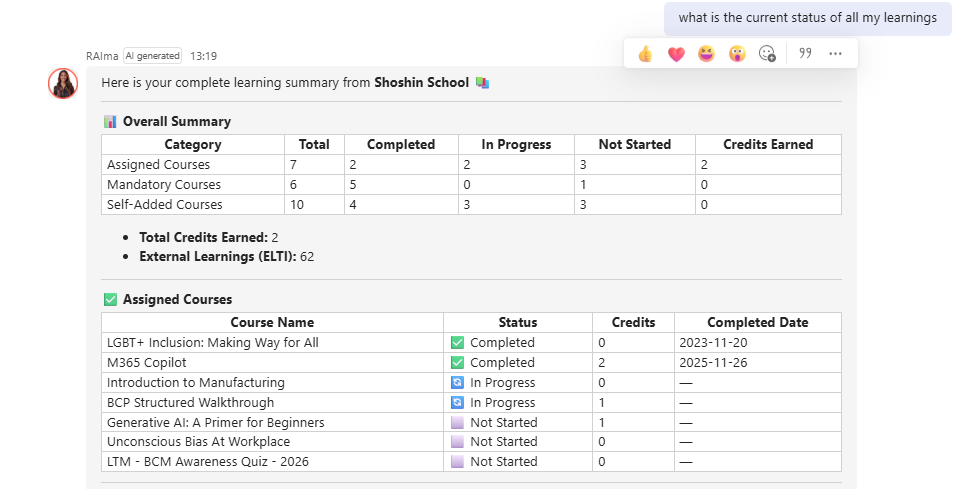
8. Learning & Growth Support
The implementation began with a clear recognition of fragmented HR systems and the growing need for personalization, speed and simplified employee journeys. Cross‑functional teams ran design‑thinking workshops to uncover pain points across onboarding, performance, learning, policies and engagement. Early prototypes were built and tested to validate usability, sentiment accuracy and workflow orchestration, with continuous feedback shaping RAIma’s persona, tone and interaction patterns.
To ensure quality and compliance, the team combined Copilot Studio’s built‑in evaluation tools with a custom testing framework that validated accuracy, safety and policy alignment. Four additional agents were developed as standalone assistants, while RAIma now unifies the experience by serving as the single entry point. Each of the four agents uses SharePoint as its knowledge source.
Policies, procedures & documentation for project/ product managers, enabling fast retrieval of information.
Offers information on office facilities, housekeeping and transport operations.
Serves as a central repository for knowledge articles, learnings, sessions and technical architecture.
Plans & procedures, resources, tools for crisis management, along with team details & contact information.
RAIma uses generative orchestration, allowing the LLM to interpret user intent and determine which tools, topics, and knowledge sources to invoke. Core capabilities are modularized into dedicated topics covering leave management, ServiceNow ticketing, learning management, and timesheet management.
"RAIma, our AI agent developed with Microsoft Copilot, is redefining the role of HR at LTM by integrating intelligence, insights, and employee services into a single, intuitive conversational interface.
As we pivot to becoming an AI-centric organization, RAIma is enabling our people with greater clarity and capability to own outcomes for our clients, helping them Outcreate every day.
It's one of the ways Business Creativity is coming to life at LTM, where human insight and intelligent systems converge to drive meaningful impact. The result is a more responsive, human-centric workplace, and an HR function that operates as a strategic enabler of business outcomes."
Chetana Patnaik, CHRO, LTM
The agent’s general instructions define its role and purpose, outline query‑routing logic, and specify citation rules, exclusion rules, and response‑generation guidelines. This structure ensures consistent behavior across scenarios and provides a scalable foundation for adding new HR workflows over time.
RAIma includes embedded personalization, adapting to role, location, skill gaps, and behaviour. This includes:
The team improved the user experience by replacing generic errors with custom messages. They implemented consistent error handling across all topics so users receive clear guidance whenever something goes wrong.
To monitor performance and adoption, the team uses Azure Application Insights for advanced analytics, capturing telemetry on usage patterns, agent performance, and user behavior.
LTM follows a structured Application Lifecycle Management(ALM) practice with development, test and production environments. Deployments were initially performed manually, but the team is now exploring pipelines to streamline and automate the process.
Distribute responsibilities across specialized agents to reduce engineering overhead and make the system easier to maintain and extend.
Connect to core systems so employees can complete end‑to‑end tasks directly within MS Teams.
Include Responsible AI and policy‑response evaluations, and address gaps through targeted prompt tuning to ensure safety and compliance before rollout.
Use the Copilot Studio integration with Azure Applications Insights to capture logs and identify intent recognition errors, routing issues, or failed backend calls in production.
LTM plans to expand RAIma with additional HR workflows, enhanced functionality, and integration with a centralized employee landing site.
RAIma shows how LTM is embedding AI across core business functions and moving toward a scalable, AI‑driven innovation model that accelerates delivery and drives value for thousands of employees.
“As we scale enterprise AI, our aim is to unlock business creativity at every level. Trusted agents handle the repeatable work, and our people bring the imagination, judgment, and client context that turn ideas into outcomes. This is how we’re building an AI-centric LTM: secure by design, grounded in governance, and focused on measurable impact.”
Rajesh Kumar, Chief Information Officer, LTM.
 Outcreate Your Business
Outcreate with LTM
Outcreate Together
Outcreate Your Business
Outcreate with LTM
Outcreate Together