

How LTM and AWS can help airlines modernize revenue management with governed, human-in-the-loop AI decision support
Airline pricing has never been short on data. It is short on time. Competitive fares, booking curves, RASM performance, NDC offers, fare filings, and demand surges are constantly changing across systems that were never designed to work together. The bottleneck is no longer access to information. It is synthesizing the right signals fast enough to act with confidence.
That is where governed agentic AI comes in. Not to take pricing decisions away from revenue managers, but to give them a faster, more explainable way to make them.
Why airline pricing needs a new operating model
Airline pricing has always been dynamic, but the pace and complexity of commercial decision-making have changed. Competitive fares, booking behavior, demand shifts, channel mix, customer response, and revenue performance now shift continuously across systems and markets.
For pricing teams, the challenge is no longer simply accessing data. It is interpreting multiple signals quickly enough to act with confidence. Teams must reconcile competitive fares, RASM/RASK performance, booking curves, bid prices, fare filings, NDC offers, and dynamic pricing signals to support daily or even hourly decisions.
Agentic AI creates an opportunity to accelerate this synthesis by monitoring signals, surfacing recommendations, simulating scenarios, and supporting human-led decisions.
The goal is not autonomous pricing. It is faster, more consistent, and more explainable decision support.
The pain points holding pricing teams back
Airline pricing teams face several persistent challenges:
- Fragmented systems and signals: Disconnected commercial systems make it difficult to build a timely, unified view of market conditions.
- Growing analytical complexity: Teams monitor more markets, routes, competitors, and demand movements, increasing prioritization challenges and the risk of missed opportunities.
- Manual processes: Smaller or less mature airlines may still rely heavily on spreadsheets, limiting automation, auditability, and scalability.
- Data latency and quality: Fare filing errors, stale competitive data, and delayed market signals can reduce decision quality and slow responses to market changes.
These constraints make it harder for revenue managers to spend time on commercial judgment rather than manually collecting, reconciling, and interpreting information.
The opportunity: governed agentic pricing
Revenue management technology has established capabilities in forecasting, optimization, bid-price science, and integrations across passenger service systems (PSS), ATPCO, and emerging Offer and Order models. Yet many airline teams still lack an agentic analyst layer that can translate complex market signals into explainable, copilot-style decision support.
New AI-native approaches are pushing the market toward greater automation, including trading-style large market models designed to generate pricing moves at speed. This creates pressure on established revenue management environments, where traditional workflows can appear slower and more manual.
Full automation, however, introduces a governance challenge. Airlines may be reluctant to transfer pricing authority to an external model without clear explainability, accountability, commercial oversight, and risk controls.
A pragmatic approach is a governed agentic workflow layer that sits above the existing revenue management and pricing estate. It does not require core systems to be replaced or pricing authority to be transferred.
Instead, it adds an orchestration layer that can:
- Monitor multiple commercial signals continuously
- Reconcile and prioritize inputs
- Identify anomalies and demand shifts
- Simulate pricing scenarios
- Generate explainable recommendations
- Apply commercial guardrails and approval policies
- Maintain audit trails and decision context
This approach reframes modernization as transformation rather than replacement. Existing pricing science remains intact, while an intelligent orchestration layer makes it faster to use, easier to explain, and safer to operationalize.
For the chief commercial officer (CCO), it also provides a clear AI pricing model: faster market sensing, governed recommendations, and human-controlled commercial decisions.
From signals to recommendations
In this new model, airline pricing moves from manually checking multiple systems to orchestrating specialized AI agents. Each agent monitors a defined commercial input, such as competitor fares, booking trends, demand shifts, market events, revenue performance, or fare filing activity.
The agents convert these inputs into structured insights. An orchestration layer then reconciles and prioritizes them, triggering deeper analysis where required and translating the results into recommendations for the revenue manager.
The resulting pricing workbench supports competitive fare analysis, market performance monitoring, demand assessment, fare comparison and normalization, model inference, and end-to-end workflow coordination.
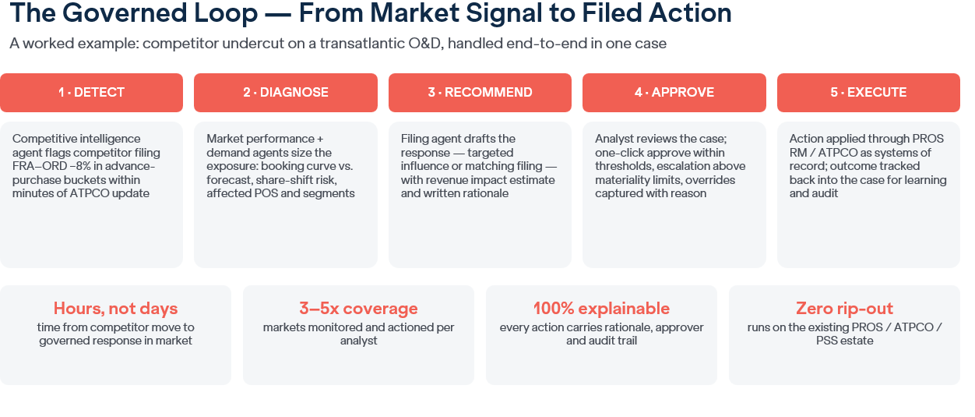
In summary, the agentic pricing workbench provides a model-agnostic orchestration layer that turns fragmented airline pricing signals into governed, explainable recommendations.
The focus is not which underlying model an airline uses. It is how intelligence is coordinated, governed, and made actionable. The framework sits above the existing revenue management estate. Agents can monitor signals, apply guardrails, reconcile outputs, and surface recommendations regardless of whether inference comes from an incumbent revenue management platform, a challenger model, or a proprietary capability.
This model-agnostic design is important as airline AI strategies diverge. Some carriers are experimenting with frontier LLMs, others are distilling smaller task-specific models for speed and cost, while some are investing in proprietary large market models grounded in their own operations research and pricing science.
As the model layer fragments, airlines need an orchestration layer that can adapt across approaches while preserving explainability, commercial control, and governance.
Reference architecture: multi-agent pricing decision support on AWS
AWS Reference Architecture
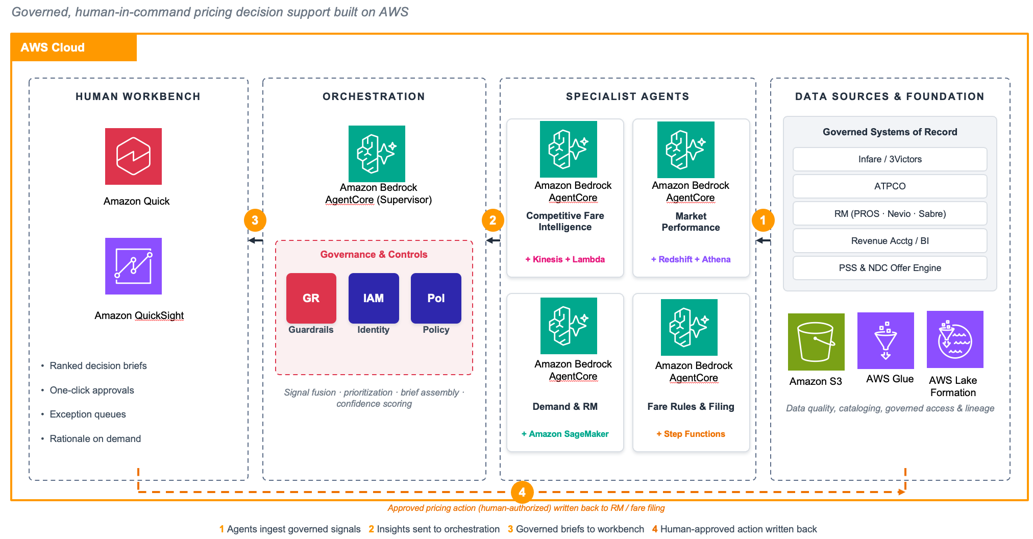
A multi-agent pricing decision-support architecture on AWS can unify airline systems, market signals, business rules, and generative AI orchestration together in a governed workbench for revenue management teams.
The design uses five connected layers: signals flow from source systems into the workbench, while approved pricing actions flow back to systems of record. This separation lets airlines modernize incrementally while keeping pricing decisions under airline control.
Data ingestion layer: This layer brings together airline-owned data such as inventory, availability, fares, bookings, and revenue, with external market and event signals, including competitor fares, OTA, and aggregator data, and demand triggers. Streaming data lands continuously, while reference data refreshes according to its defined cadence.
- Data quality and transformation layer: This layer cleanses, normalizes, and matches fare and OND data so inputs are comparable and decision ready. Airline-defined rules standardize market definitions, cabin mappings, fare classes, and currency handling before agents reason over the data.
- Decision-support agents compare fares, normalize inputs, flag anomalies, simulate scenarios, and assemble recommendations with rationale so teams can prioritize markets and act with confidence.
- Orchestration layer. This layer coordinates agents, reconciles conflicting signals, triggers deeper analysis when confidence is low, and applies commercial guardrails, approvals, identity, and policy controls before recommendations reach a human.
- Human workbench. The workbench provides revenue managers with a single surface for dashboards, alerts, simulations, approvals, and recommendation rationale. Human judgment stays in command: no price move is executed without authorized review.
- Agent layer. Specialized agents operate on prepared data, each handling a focused task so outputs remain inspectable, explainable, and easier to govern.
- Signal agents monitor competitive fares, booking curves, revenue performance, demand indicators, events, and channel activity to detect meaningful market movement and convert fragmented inputs into structured signals.
The workbench is only as strong as the data behind it. Timely, trusted, and complete signals are essential for agents to generate recommendations that are fast, explainable, and commercially reliable.
Data foundation: recommendation quality starts with signal quality
Before scaling agentic pricing, airlines need a trusted foundation across owned data, market data, and external demand signals, so agents reason over fresh, complete, and decision-ready inputs.
Core data inputs include:
Airline-owned data: Bookings, inventory, availability, and revenue signals
- Market and competitive data: Published fares, OTA prices, aggregator data, and competitor fare movements
- Event and demand data: Local events, demand surges, and other external triggers
Business outcomes: Where the value shows up
- Accelerated pricing decisions: Revenue managers can move faster from signal detection to recommendation review, reducing manual analysis and improving responsiveness to competitive fare movements.
- Earlier demand-shift detection: Continuous monitoring of bookings, market events, competitor actions, and channel behavior helps teams identify demand inflections before they materially affect revenue performance.
- Improved scenario simulation: Teams can compare pricing options, assess potential commercial impact, and summarize the rationale in a consistent, explainable format to support faster approvals.
- Stronger commercial alignment: A shared workbench creates a common view across revenue management, sales, marketing, network planning, and commercial leadership, improving coordination around market actions.
- Higher campaign effectiveness: Connecting pricing intelligence with market signals and commercial actions can support more targeted offers, better-timed campaigns, and improved conversion opportunities.
Beyond fares: Extending agentic pricing to ancillaries
Published fares are a natural starting point, but the same data-and-agent orchestration model can extend to ancillary products such as seats, bags, Wi-Fi, priority services, and other paid offers.
To scale effectively, airlines should define clear comparison logic, trusted data sources, pricing guardrails, and approval workflows so ancillary recommendations remain explainable, governed, and commercially aligned.
Responsible adoption: Governance comes first
- Human approval remains mandatory: Pricing recommendations are reviewed and approved by revenue managers before price changes are executed. In the AWS architecture, this control is enforced structurally. Amazon Bedrock AgentCore routes each recommendation to a human approval step, while AWS Step Functions can explicitly model the approval workflow and pause execution until authorization is provided. No agent has a direct write path to a fare filing or inventory system without this human gate.
- Business guardrails govern decisions: Airline-defined rules establish thresholds, exceptions, approval levels, and escalation paths. Amazon Bedrock Guardrails can constrain agent outputs, while airline-specific thresholds, such as maximum fare movement, protected markets, and fare-class limits, can be applied within the orchestration layer before a recommendation reaches a human. AWS Identity and Access Management (IAM) and resource-level policies define which agents can access specific data and actions, reinforcing these boundaries at the platform level.
- Agents augment, not replace, core systems: The agentic layer operates above existing revenue management, pricing, inventory, and fare filing systems, preserving systems of record. AWS supports this pattern through governed integration points. Agents can read from and write to existing estates, including PROS, Nevio, Sabre, ATPCO, and PSS environments, using services such as Amazon API Gateway and AWS Lambda for connectivity and AWS Glue for data preparation. AWS Lake Formation can govern access to underlying data through fine-grained permissions and lineage, keeping systems of record authoritative while making data access auditable.
- Adoption should be phased and evidence-led: Airlines can begin with lower-risk markets, validate recommendation quality and business outcomes, and expand once governance is proven. The architecture supports this approach through limited market deployments, with Amazon CloudWatch and AWS CloudTrail providing observability and audit trails for recommendation quality, latency, and outcomes. Because the layers are decoupled, airlines can prove value within a defined market segment without rearchitecting the platform as adoption expands.
Conclusion: Intelligent pricing decisions, not black-box automation
The future of airline pricing is not about replacing revenue managers with autonomous models. It is about giving commercial teams a better operating system for decision-making.
Multi-agent AI can help airlines move from fragmented market monitoring to governed decision intelligence by connecting fare, demand, event, competitive, and performance signals into a coordinated pricing workbench. With the right architecture and controls, airlines can respond faster to market change while keeping human expertise firmly at the center of pricing strategy.
Ready to explore agentic pricing for your airline?
LTM, together with AWS, can help travel and transportation organizations identify high-value agentic AI pricing use cases, validate business impact, and design governed architectures that scale from proof of concept to production.
The right starting point is not full automation, it is a focused, measurable pricing workbench that proves value, builds trust, and creates a path to responsible AI-enabled revenue management.
Learn more about LTM and AWS partnership - AWS Partner Solutions & Consulting Services | LTM
Explore our Travel, Transport and Hospitality offerings - Travel Technology & Hospitality Consulting Solutions by LTM


 Outcreate Your Business
Outcreate with LTM
Outcreate Together

It’s time to Outcreate